Election 2026
Risk to the 2026 Election

American elections are hard to break. They run in more than 10,000 separate jurisdictions, nearly every vote is cast on paper, and every state audits its results. This page tracks the real pressures on the 2026 midterms, from Election Day on Nov. 3 through counting, certification and the seating of Congress on Jan. 3, 2027. It separates documented actions from online chatter. We won't play risks down, and we won't play them up. Read our analysis at America 2.0 →
11:58 p.m., Nov. 3. Polls have closed in most eastern states. President Trump told The New York Times on Tuesday night that he is “absolutely willing to accept those results” and would work with Democrats. America 2.0 does not call races; the AP projects that Democrats have retaken control of the Senate; NBC News, CNN and other news organizations project Democrats will also win the House, which the AP has not yet called. It projects that former Gov. Roy Cooper (D) won North Carolina’s Senate race, flipping a Republican-held seat, that Democrat Annie Andrews defeated Sen. Darline Graham (R) in South Carolina, another flip (Graham has conceded), that state Rep. James Talarico (D) defeated Attorney General Ken Paxton (R) in Texas, former Sen. Sherrod Brown (D) won Ohio’s special Senate election, Josh Turek (D) defeated Rep. Ashley Hinson (R) in Iowa and Adam Hamilton (D) ousted Sen. Roger Marshall (R) in Kansas, flipping four more Republican-held seats, that Rep. Chris Pappas (D) won New Hampshire’s open seat, that Sens. Jon Ossoff of Georgia and Mark Warner of Virginia were re-elected (his opponent, Rep. Mike Collins, has conceded), and that Sen. Ashley Moody (R) won Florida’s special Senate election; it projects Rep. Byron Donalds (R) won Florida’s governor’s race and Democrat Keisha Lance Bottoms flipped Georgia’s governorship; in the House, it projects that Democrats Jamie Ager flipped North Carolina’s 11th District and Pia Dandiya won Florida’s redrawn 22nd, Rebecca Bennett unseated Rep. Tom Kean in New Jersey’s 7th, Zach Dembo flipped Kentucky’s 6th, and Paige Cognetti and Bob Brooks unseated Reps. Rob Bresnahan and Ryan Mackenzie in Pennsylvania, where Rep. Scott Perry (R) also lost (see where to follow results). Problems remain local: Dearborn, Mich., had reports of precincts briefly running out of ballots amid heavy turnout, its mayor says; a false fire alarm closed a Kingston, Pa., polling place for about an hour, and the county asked a judge to keep it open until 9 p.m.; bomb threats in Toledo and Gibraltar, Mich., were not credible (after the Toledo threat closed a polling place for nearly two hours, a judge allowed provisional voting there until 9:15 p.m.; Ohio Secretary of State Frank LaRose said he disagrees and expects those ballots to be challenged, <a href="https://www.wtol.com/article/news/politics/elections/frank-larose-beverly-elementary-toledo-extended-voting-hours-provisional-ballots/512-65c356cb-4c28-4e9f-b1ae-14e1ce2459f6">WTOL</a>), and in Richmond, Va., police found no evidence of an immediate threat after shooting and bomb threats at three polling places, where voting continued. The federal pressure stands: the Ninth Circuit order freeing DOJ to warn officials remains in effect, and the union challenging it has asked all 29 judges to rehear the case. In Alaska, Sen. Dan Sullivan called the second Sullivan on the ballot “the biggest cheating scandal in Alaskan history”; that candidate is on the ballot by court order, and the official ballot marks the senator as the incumbent. The National Republican Senatorial Committee opened a recount fund for the race on Tuesday, according to an FEC filing reported by CNBC. “Elevated” reflects that pressure. Expect slow counts in Maine, Alaska and NY-17; a slow count is not evidence of fraud.
What would change this rating ↓
election2026.america2.newsGet America 2.0 in your inbox
Sober analysis of threats to democracy, information warfare and the networks behind them. Free; unsubscribe anytime.
Start here: why the system is hard to break
The risks below are real, but they come up against a system built with redundancy. To change an outcome, someone would have to defeat several of these safeguards at once, in many places, without being noticed.
- ~99% on paperNearly every voter will cast a ballot with a paper record that can be recounted by hand (BPC, Verified Voting). About 70% of voters mark their ballot by hand.
- 50 of 50 states auditEvery state now has a post-election audit law that checks machine counts against the paper (NCSL).
- 10,000+ jurisdictionsElections are run locally, on different equipment under different rules. No single switch exists to flip or stop them (EAC).
- A hard targetVoting machines are typically not connected to the internet or to each other (2024 intelligence assessment, via PolitiFact). Officials in every state test equipment before each election (BPC).
- The date is fixed by lawOnly Congress can change Election Day. The president can't postpone it (CRS).
- Courts are holdingMost federal moves to change election rules this year have been blocked or narrowed in court. When counties refused to certify in 2022, courts ordered them to.
- Officials in both parties push backRepublican election officials in Utah, Idaho and Georgia have resisted federal pressure alongside Democratic ones.
- No altered votes on recordExperts say there is no evidence machine vulnerabilities have ever been used to change a real U.S. election.
Viral claims, checked
The claims spreading fastest right now, and what the record shows.
Election Day’s False Claims, and Who Set the Record Straight
Claims made before results are in can be used to dispute them later. We list the most-shared ones from public figures now, beside the record, so they can be weighed if they return. Reach as of 3:20 p.m. ET, Nov. 3.
Contradicted by the record.
- Katie Miller, a podcaster married to White House deputy chief of staff Stephen Miller (445,000 views): Westchester is “turning away voters”; “This is how the Left steals elections” (X). Voting continued on paper; the bags are “a standard emergency protocol aimed at ensuring that voting continues without disruption” (NYT). The state Board of Elections traced the failure to a programming update after a contest changed (Lohud).
- Laura Loomer (143,000 views): “Democrats are already trying to steal the election in New York today” (X). The county board is run by one Democratic and one Republican commissioner, and both parties are seeking a joint court order to count the bagged ballots centrally (RNC).
- Joey Mannarino, a pro-Trump influencer (175,000 views): “MASSIVE AMOUNTS OF VOTER FRAUD BEING REPORTED ALL OVER THE COUNTRY!”, pointing readers to the RNC’s election-protection account (X). That account’s own posts report the joint court order, not fraud (RNC); we found no report of fraud today (details).
- Rasmussen Reports (127,000 views): “The machine settings most likely have been adjusted to reject them” (X). The state board says a late change to one contest required a programming update; there is no evidence settings were changed to reject ballots (Lohud).
- Benny Johnson, a commentator who worked for Tenet Media, the network U.S. prosecutors say RT secretly funded; officials called its commentators unwitting, and he says he was a victim (BBC) (136,000 views), on NBC: “They’re going to declare Democrats in control of the Senate and the House before they even know the actual winners” (X). NBC said it would project control only if results bear out the polls, and that determining the winners will more likely take time (NBC News, X).
Not false, but out of proportion: the federal government. ICE: “There will be no escape” (2.7 million views; X). Homeland Security Secretary Markwayne Mullin: DHS will “hunt you down” (315,000 views; X). Attorney General Todd Blanche, Nov. 2: California has “thousands of illegal voters” on its rolls (X). Illegal voting is a crime, and it is rare: the Justice Department has charged about 236 people since January 2025, against more than 158 million ballots cast in 2024 (NYT). Of the department’s list of about 20,000 California names, 42% match no one on the state’s rolls (AP).
Satire, read as news. A parody pollster account styled “Dr. Nate G. Lichtman,” a mashup of the forecasters Nate Silver and Allan Lichtman (384,000 views): “I am beginning to see something in the Election Day data that I had hoped never to see again… One of them is visibly trembling.” It is a joke, not an analysis; neither forecaster wrote it, and it offers no data.
Set the record straight.
- Rep. Mike Lawler (R-N.Y.), whose seat is at stake (909,000 views): “every ballot will be counted. Stay on line and vote” (X).
- The RNC’s election-protection team joined Democrats in seeking central counting of the bagged ballots (RNC).
- The New York State Board of Elections and Westchester County explained the cause and kept voting open (Lohud; Westchester County).
- Ken Bensinger of The New York Times: “FALSE: Voters are not being turned away” (X).
- Lucas County, Ohio, officials reopened a Toledo polling place within two hours of a bomb threat police called “not credible” (Toledo Blade).
Watch. Whether these claims are repeated after the polls close, when counts are slow.
Westchester’s Scanners Failed; the Paper Ballots Are Being Kept
The claim. Posts call the outage a planned trick to steal NY-17. Laura Loomer: “Democrats are already trying to steal the election in New York today” (X). Rasmussen Reports: “The Old Paper-Don’t-Fit Trick… The machine settings most likely have been adjusted to reject them” (X). Katie Miller, a podcaster married to White House deputy chief of staff Stephen Miller: “This is how the Left steals elections… they are turning away voters” (X).
What’s happening. On Tuesday morning, scanners at polling sites across the county stopped accepting ballots. The Board of Elections first blamed ballot “thickness,” then withdrew that and said only that the issue involves the paper ballots (Talk of the Sound). The state Board of Elections says the cause was a programming update: a contest in one municipality changed after the county’s Election Day equipment had been prepared and tested, and it has found no similar problems elsewhere in the state (Lohud). Voters are still voting on paper; ballots go into secure orange emergency bags to be counted (Westchester County). Voters are not being turned away; the Times calls the bags “a standard emergency protocol aimed at ensuring that voting continues without disruption” (NYT). Republicans and Democrats are seeking a joint court order to count those ballots centrally at the Board of Elections, the RNC says (RNC). Rep. Mike Lawler, the Republican whose seat is on the ballot, says “every ballot will be counted” (X).
Why it matters. Paper is the backstop: a scanner failure on paper ballots delays the count; it doesn’t erase votes. County Executive Ken Jenkins has ordered an investigation (Gothamist). Watch the court order and when the bags are counted.
Iran Strikes: Planned, Reportedly for After the Vote
The claim. Since Oct. 29, posts have argued that a cornered president, facing a likely loss of both chambers, canceled his weekend rallies to prepare an attack on Iran before Tuesday’s vote, in a bid to topple Iran’s government and change the political calculus at home. Some versions say he could use nuclear weapons. The most-shared posts on the rally cancellations come from an account styled “US Homeland Security News,” which is not a government account (about 626,000 followers; 2,400 likes): Trump “is preparing for War! … May Start At Any Time!!” The most-shared “nuke” version credits Sen. Chris Murphy with hinting at it (1,800 likes). Murphy said nothing of the kind.
The strongest case for it.
- The plans are ready. U.S. forces can launch major operations against Iran “within 96 hours of receiving” an order, two U.S. officials told CNN. Targets include energy infrastructure, military sites and nuclear facilities, and some officials say it is “a question of when, not if” (CNN). On Oct. 29 the head of Central Command, Adm. Brad Cooper, briefed Trump in person at the White House, with Defense Secretary Pete Hegseth and Gen. Dan Caine. The Wall Street Journal notes that Cooper rarely does this, so the visit could signal the U.S. is moving closer to significant military operations. The Pentagon is sending a Patriot battery to Israel and has moved troops off exposed bases (WSJ). A third U.S. aircraft carrier and thousands of additional troops are headed to the region. On Oct. 28 Defense Secretary Pete Hegseth fired the Joint Staff’s top military planner, Lt. Gen. Brett Sylvia (AP via PBS); a Pentagon official told CBS News he was accused of leaking classified information about the Iran war (CBS News).
- Pressure in the Gulf is rising. Iran says four tankers hit mines in the Strait of Hormuz, and the UK Maritime Trade Operations agency reported a small boat attaching explosives to a tanker off Oman, disabling it. Iran’s Revolutionary Guards dispute Central Command’s claim that the main shipping lanes are clear of mines (CNBC).
- The motive is visible. Forecasters give Democrats strong odds in the House and better than even odds in the Senate (see the forecasts). This week Inside Elections shifted 63 races toward Democrats, and new CNN polls show Democrats leading in Michigan and Texas (CNN). A war, or an emergency tied to one, would change the subject in the final days.
- The rallies were briefly canceled. On Oct. 29 Trump canceled weekend rallies in Kansas and Iowa in favor of tele-rallies; he said Kansas Sen. Roger Marshall was “doing very well” (NBC News). Hours earlier he had lashed out at a reporter who asked whether he canceled for health reasons (New York Times; CNN). Less than a day later the White House put both back on for Sunday (see below). Vice President JD Vance also canceled a Friday “War on Fraud” announcement in St. Cloud, Minn., billed as official business; the U.S. Attorney’s Office gave no reason (MPR News; CNBC).
- Israel has pushed for a strike before the votes. An Israeli source told CNN that Netanyahu “really wanted and tried to convince Trump for a joint attack in Iran before the elections,” and that Trump did not give a green light (Times of Israel). The Financial Times reports that Netanyahu had the military prepare a multi-day campaign for the weekend of Oct. 10 (FT).
- Trump’s words leave the door open. “We may do another little Epic Fury,” he said at a rally last week. “Or they’ll agree” (WSJ). Asked about the post-election plans, a White House official said Trump “keeps all options on the table” (VOA). On election eve he said there was “no rush” but that the U.S. “might need to go after Pickaxe,” a site linked to Iran’s nuclear program, which he called “not a big deal” (BBC). Murphy, who says he was briefed on some of the planning, called it “insane”: “It will lead to devastating escalation and the likely destruction of our commitment to the rule of law” (WSJ).
What the record shows.
- Timing: after the vote. Every detailed report puts the strikes after Nov. 3. The New York Times describes plans “for renewed strikes against Iran after the American midterm elections” (NYT). U.S. officials told Gulf allies to prepare for a campaign after the election (AP; WSJ). CNN’s sources say “most likely after the US midterm elections” (CNN). Advisers told The Atlantic a new round “could come soon after Tuesday’s midterms”; the options before the president run from strikes lasting a few hours to several weeks, keeping the naval blockade in the Strait of Hormuz, or walking away (The Atlantic). Trump has ruled out military action before the midterms (VOA), though limited strikes have continued (see below). He has also “repeatedly canceled plans for a return to major combat” (NYT). The AP’s diplomatic sources say Trump has not made a final decision (PBS).
- Limited strikes, before the vote. Late on Nov. 2 U.S. forces struck surface-to-air missile sites on Iran’s Qeshm Island that were being used against U.S. assets; officials called the strikes “defensive” and not a return to full-scale war (Guardian, citing Reuters and AP). U.S. officials told CBS the strikes answered Revolutionary Guards fire on a U.S. aircraft (BBC). The Wall Street Journal, which first reported it, says it was one of a series of smaller strikes in recent weeks that the administration kept quiet so as not to signal a wider campaign. Central Command has not commented. The same day, Vance said he and Trump “feel pretty good” about a negotiated settlement.
- The president, on Election Day. In a six-minute FT interview hours before polls closed, Trump said the US had no immediate plan to strike Iran: “We’re locked and loaded if we need to go, but there may be no reason for it.” He said indirect talks on Iran’s enriched uranium were continuing (FT).
- The rallies are back. On Oct. 30 the trips were restored: Trump will hold back-to-back rallies in Kansas and Iowa on Sunday, a person familiar with the plans told the AP, rearranged around the new tele-rallies (AP via KCRG). The Salina Airport Authority confirmed a 2 p.m. Sunday rally in Salina, Kan. (WIBW); A White House official confirmed to NBC News that Trump will rally Sunday in Salina, Kan., then Cedar Rapids, Iowa (moved from Dubuque); a source said the rallies were “rearranged for scheduling purposes to accommodate nearly 20 additional tele-rallies” (NBC News). No report links the cancellation or the reversal to Iran. The stated reason is the Republican Party’s, and the reporting also raises the president’s health.
- A diplomatic track is open. Vance sent a letter via Qatari mediators to Mohsen Rezaei, secretary of Iran’s Supreme National Security Council, proposing early talks, with Vance offering to lead the U.S. team (New York Times and Wall Street Journal, via CBS News). Trump says the outreach is about medical supplies. On Oct. 30 he said the war is “going to get wrapped up soon” and “We need a guarantee there’ll never be a nuclear weapon” (Reuters).
- Nuclear weapons. No report, official or document points to nuclear use. The plans target Iran’s nuclear facilities, which is not the same thing. Murphy did not mention nuclear weapons.
- What a strike could and couldn’t do to the vote. A strike would not change ballots already cast or how they are counted. The risks to the election run through the channels this page already tracks: emergency declarations, turnout, and Iranian retaliation against U.S. infrastructure (see the risks). Posts saying a strike would cancel Tuesday’s vote run into the same limit: Election Day is set by federal statute, and only Congress can change it (see the claim).
- Air defenses now guard the president’s Florida home. By Oct. 24 the military had deployed ground-based air-defense and counter-drone systems at and around Mar-a-Lago at the Secret Service’s request. Snopes identified them as likely Avenger units, which fire Stinger missiles. Neither agency gave a reason beyond a “heightened threat environment” (Snopes).
What would change this. A strike order or a strike before Nov. 3. Any emergency declaration tied to Iran that touches voting or the count. Iranian cyberattacks on election offices or the power grid.
Bottom line. A renewed U.S. campaign against Iran is credibly reported as planned and close, and the president’s political position gives a motive to move. So far the reporting places it after the vote, a diplomatic channel opened this week, and nothing supports the nuclear version.
Poland’s Court Fight, Recast as a Midterm Preview
The claim. Ahead of Nov. 3, American and Russia-aligned accounts are presenting Poland’s fight over its constitutional court as a rehearsal for a “coup” in the United States, with Poland’s prime minister cast as a stand-in for US Democrats. Fox News host Laura Ingraham wrote that “America should watch what the globalists are trying to pull in Poland. Another warning to us” (X). Mike Benz called it a coup by a faction tied to “the Democrat Party in the U.S.” (X); a group behind the US “color revolution” posts said “America is next.”
What happened in Poland. Two camps are fighting over who runs one court. Police stayed outside the building, and we rate a coup there “not now” (Poland tracker →).
Why it matters. The frame is portable: expect it to be pinned on close races, slow counts or certification fights here, and tied to the “color revolution” claim below. Who is pushing it →
The Alaska “Two Sullivans”
The claim. The Justice Department says Alaska voters may confuse Sen. Dan S. Sullivan with a second candidate, Daniel J. Sullivan Jr., and has asked a federal judge to block certification of the Senate race if the senator loses but would have won with the second man’s votes (complaint).
What the ballot shows.
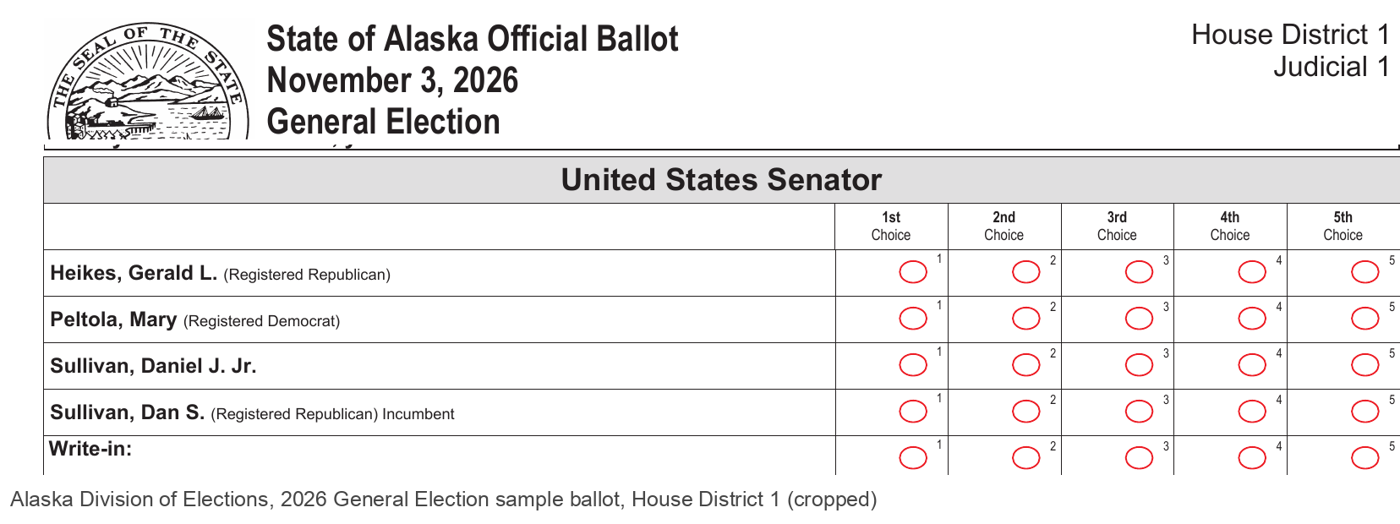
The history. In June, Alaska’s elections director found the challenger had filed “to confuse or mislead,” noting he had asked to appear as “Dan Sullivan” with a Republican label; a state trial court ordered him back on the ballot, and the Alaska Supreme Court affirmed on June 29 (complaint). He has said he decided to run on his own; Republicans call him a Democratic plant (AP). On Oct. 23 President Trump told reporters he had ordered the suit: “I’m the one that said, ‘do it’” (PBS).
On Oct. 28 the New York Times reported that Democrats ran a monthslong, secret effort to fill the ballot with spoiler candidates, including this Mr. Sullivan and Gerald Heikes. The Times cites interviews with 12 people, dozens of text messages and documents prepared for a possible lawsuit, and says aides to the Democratic nominee, Mary Peltola, and senior staff at the Democratic Senatorial Campaign Committee took part. Both deny recruiting any candidate, and Mr. Sullivan says he entered the race on his own. Peltola’s former campaign manager, a main source, later asked to retract her statements; the Times says her account matched its other reporting. Ballot-stacking is generally legal, the Times notes, and both parties have used it in Alaska (NYT).
On Oct. 28 Gov. Mike Dunleavy, a Sullivan supporter, directed the Alaska Department of Public Safety to investigate “whether this scheme violated Alaska’s laws and whether criminal charges or civil action are warranted.” President Trump said the same day that Peltola should be prosecuted (Juneau Independent; Washington Post). The Times itself noted that ballot stacking is common and generally legal, and election-law scholar Rick Hasen says prosecuting a candidacy over its backers’ motives would be legally questionable: “This stuff happens all the time” (Juneau Independent). On Election Day the Justice Department sent letters to about 20 Democrats warning they may be targets of its investigation into the recruitment, two people with knowledge of the move told the Times; the intended recipients include elections lawyer Marc Elias, whose firm has represented Ms. Peltola, and at least one official at the Democratic Senatorial Campaign Committee. The Times calls such a notice at the decisive moment of a close race highly unusual (NYT). On Election Day, Sen. Sullivan accused Peltola and Senate Minority Leader Chuck Schumer of devising a “scheme” and called it “the biggest cheating scandal in Alaskan history” (CNN).
The Justice Department has since begun issuing subpoenas to several Democratic officials believed to be tied to recruiting Daniel J. Sullivan Jr., and amended its suit to call the situation a “conspiracy to undermine the integrity of the electoral process”; no one has been charged. A department official told reporters on Oct. 29 that the department was not aware of any confirmed case of a voter mistakenly choosing the wrong Sullivan (CBS News). On Oct. 29 the department expanded its criminal investigation, sending dozens of new grand jury subpoenas, people familiar with the matter told the Wall Street Journal. Recruiting long-shot candidates is not usually illegal unless combined with another violation, such as lying to a court, and the ranked-choice tally won’t happen before Nov. 18, the absentee-ballot deadline, so the winner may not be known for weeks (WSJ). The FBI has also begun contacting people who donated to Daniel J. Sullivan Jr.; some told the AP that agents asked whether they had been misled about which candidate they were supporting (AP).
CNN’s Aaron Blake notes that Daniel J. Sullivan Jr. won 2.5% of the primary vote, that ranked-choice voting lets a confused voter rank both Sullivans, and that nearly 60,000 Alaskans had already voted early or absentee by early this week (CNN analysis). Alaska’s count will be certified under Lt. Gov. Nancy Dahlstrom by Division of Elections Director Carol Beecher, who in 2023 tried to pull the state out of the bipartisan voter-roll system ERIC, citing election-denial claims about it, and who gave the Justice Department an unredacted copy of the state’s voter rolls last year (TPM).
On Oct. 30 the Justice Department also asked the judge to order ballots “that may be impacted by voter confusion” set aside. On Oct. 31 Alaska’s Republican-led government asked the judge to dismiss the suit. It called the demands “inappropriate and not even possible given Alaskan voters’ vital right to ballot secrecy” and the idea of separating ballots “both disturbing and impossible.” On Nov. 1 Sen. Sullivan himself, asked on CNN whether he would accept the results only if he wins, said: “No. I’m going to accept the election results” (Washington Post).
On Nov. 1 U.S. District Judge Sharon Gleason dismissed the suit. She wrote that the relief sought is “infeasible” because ballots already cast have been mixed together and cannot be matched to voters, and that the department offered “no workable plan” to segregate and investigate ballots “in a manner that would preserve voter secrecy.” She also found the bid ran counter to the Constitution’s grant of election authority to the states, and cited the Purcell principle against changing rules close to an election (AP).
Why it matters. The suit asks a federal court to hold back a state’s certified result, on a theory an election-law scholar called “strange and unusual” (CNN), filed hours after the attorney general said it is not the department’s intention to interfere. The court refused, so this page’s “Would move to High” line did not trip. The department filed notice of appeal the same day (AP); an appeals-court order before the count would be the next thing to watch.
The “Color Revolution”
This claim now has its own tracker: Color Revolution →
The claim. Viral posts allege that Democrats, former national-security officials and allied activist groups are plotting a coup: if Democrats win in November, protests would provoke President Trump into invoking the Insurrection Act, and organizers would then declare the federal government illegitimate and shift power to Democratic governors. Supporters call it a “color revolution.” No public evidence shows plans for violence or a seizure of power.
The story being told. In plain terms, the narrative casts the parts like this:
- The villains: former national-security officials, veterans of USAID’s democracy programs, and mainstream civic and legal groups, among them Indivisible, No Kings organizers and the election lawyer Marc Elias, recast as a trained network turning regime-change tools used abroad against Americans (X Space).
- The heroes: President Trump, his administration and the online researchers who say they exposed the plan, cast as defenders of a legitimately elected government under attack from within.
- The plot: Democrats win or contest the midterms, protests goad Trump into invoking the Insurrection Act, and organizers then declare the federal government illegitimate and shift power to the states.
- The twist: ordinary election protection, such as poll monitors, voter hotlines, lawyers, contingency planning and peaceful protest, is presented as proof of the conspiracy.
- What it’s for: the frame works whatever the result. If Republicans win, protests and legal challenges become “the coup” in motion; if Democrats win, the result itself can be called the product of a plot. Either way it supplies a ready justification for investigating, arresting or prosecuting opponents, and its promoters are already calling for that: “Find these traitors and arrest them” (X).
What the evidence shows. As far as the public record shows, the claim has no basis in fact. The leaked material, as described publicly, is contingency planning for a possible crisis, not plans for violence or a seizure of power. Even CynicalPublius said on the Space that it is “very hard to prove in a court of law that what they’re doing is criminal” (X Space). What the narrative does is lay groundwork for treating political opponents as criminals no matter how the election turns out.
Where it started. On Oct. 17 Jennica Pounds, who posts on X as DataRepublican, posted that the Insurrection Act would be “the trigger to pull off their coup” (X), then released a series over Oct. 18–21 built on recordings she says leaked from meetings of democracy-reform groups and former officials. Summaries of those meetings describe contingency planning for a possible legitimacy crisis, such as an options memo for governors; “coup” and “foot soldiers” are her reading. The Washington Post separately reported that US national-security officials have been quietly advising states on how to prepare for interference (Washington Post).
How it spread. Within hours the account CynicalPublius called it a “CIA-style color revolution” (X; 10,000 reposts). Sen. Mike Lee (X), Michael Flynn, who registered in 2025 as a consultant on Republika Srpska’s US lobbying contract at $100,000 a month (FARA), Glenn Beck, Lara Logan, Mike Benz (X) and former USAID official Pete Marocco amplified it; Elon Musk replied “Troubling” (X). By Oct. 21–22 it reached Dan Bongino’s outlet (X), Liz Wheeler (X), Frank Gaffney (X) and Promethean Action (X), the renamed LaRouche PAC (FEC). In a three-hour X Space on Oct. 22, DataRepublican called the material “the first time we’ve seen an operational plan to actually pull it off,” and described groups’ plans to staff Election Day “with monitors and lawyers and hotlines” as “part of the building process” for challenging the results. Asked whether the administration was aware, co-host CynicalPublius said “the White House deputy chief of staff liked my article about the color revolutions,” and DataRepublican added that “the right people know” (X Space).
Where the frame comes from. “Color revolution” is the Kremlin’s term for Western-backed uprisings (CSIS), and US commentators applied it to Trump’s opponents in 2020 (Yahoo News). In our search we found no Russian state-media seed for this version; it began on US accounts.
Why it matters. A belief that opponents are plotting a coup can be used to justify treating legitimate post-election protest or legal challenges as sedition. Watch for officials adopting the claim. That is already happening: on Oct. 20 Michael Flynn posted “Find these traitors and arrest them,” tagging President Trump (X).
Stella Parton’s Touchscreen
The claim. Singer Stella Parton says that when she voted early near Nashville, the touchscreen kept defaulting to Sen. Marsha Blackburn until her third try. “Don’t let them rig this election,” she wrote on Facebook, and she repeated the account on X on Oct. 23 (Tennessean; X).
Read the fact-checks. “Why reported challenges with touchscreen voting machines don’t signal election rigging” (AP, via ABC News, Oct. 22) · Tennessean: how to verify your ballot · WSMV: one complaint in about 400,000 ballots · Verified Voting: vote flipping and calibration
How it spread. Similar posts from Democratic voters in Kansas, Ohio, South Carolina, Tennessee and Texas have drawn tens of thousands of likes and shares, some reading them as a scheme to flip votes to Republicans (AP).
What officials found. Tennessee’s election coordinator called it “not a vote-flipping situation” but “an unintended touch”; Williamson County found no discrepancies in its equipment; Kendall County, Texas, recalibrates its screens every few days; South Carolina has seen no unusual rise in complaints (AP). The state reported one such complaint out of about 400,000 ballots (WSMV). The same complaints surface every election, in both directions (Texas Tribune, 2024).
Why screens misread taps. On older touchscreen voting machines, the touch-sensitive layer sits above the display and is calibrated to map taps to the buttons beneath. It can drift, and a voter’s height, viewing angle or a resting hand can make a tap register on the next line, computer scientists Matt Blaze and Dan Wallach have explained (Blaze; Verified Voting). Recalibrating takes a minute or two and doesn’t touch votes already cast; election-security groups urge it daily during early voting (Verified Voting).
What to do. These machines print a paper ballot. Check the review screen and the paper before you cast it, and ask a poll worker if anything looks wrong.
Why it matters. The experience is real, but nothing shows votes being changed. Treating screen errors as rigging erodes trust in a count that can be checked against paper.
“Trump Told on Himself”
The claim. Donald Trump and Elon Musk admitted in public that the 2024 election was rigged, and are hinting at the same for 2026. A spreadsheet of their quotes circulates as proof, along with new clips. People sharing it often concede they can’t say how it was done: “You don’t need to know how they did it.”
The short answer. With the full sentences restored, the quotes are about turnout and poll watching. The swing states counted on paper and checked that paper by hand, and only one state’s margin came close to a recount trigger. Tap any item for the details.
What Trump said
Cut short“We don’t need votes” and other 2024 rally quotes
The spreadsheet trims its quotes, often at an ellipsis. The rest of each sentence:
- “We don’t need votes” (Detroit, June 15, 2024): “We need to watch the vote. We need to guard the vote” (transcript).
- “I don’t need any votes” (Washington, June 22, 2024): “All I want to do is make sure that we guard our vote” (transcript).
- “Make it too big to rig” (Butler, Pa., Oct. 5, 2024): “at a certain point, their cheating doesn’t matter.” A turnout slogan: win by enough to outweigh the fraud he claims Democrats commit (transcript).
- “You won’t have to vote anymore” (West Palm Beach, July 26, 2024): the same passage urges Christians to “vote early, vote absentee, vote on election day.” Days later he said he meant Christians who usually don’t vote (transcript; Fox 5).
- “Our little secret” with Speaker Mike Johnson (New York, Oct. 27, 2024): Johnson said the next day it was their get-out-the-vote strategy (Fox News).
- Musk “knows those computers” (Pittsburgh, Nov. 4, 2024): in the same riff Trump said Musk told him computers “aren’t meant for this” and “the only thing you can do is paper ballots” (transcript). PolitiFact rated the claim that Trump admitted rigging False (PolitiFact).
Turnout boast“Pleasantly surprised on Tuesday” (Oct. 27, 2026)
Turnout boast“My two big monsters” (Perry, Ga., Oct. 24, 2026)
Clips circulate captioned “two big monsters who are going to make history next week.” What he said: “I’d like a little advice from my two people, my two big monsters that are gonna do so well. They’re gonna be the biggest stars in the country in a week” (transcript).
It came in an aside about whether to boast of oil-industry profits, at a rally for Georgia Senate candidate Mike Collins and governor candidate Rick Jackson, both of whom he promoted from the stage. “Gonna do so well” and “biggest stars in the country in a week” read as a prediction that his candidates win on Nov. 3.
Watching“Big surprises” from Russ Vought (Oct. 2026)
- Oct. 6, Baltimore shipyard event: “Russ Vought, who is fantastic… We have some big surprises coming up in another few weeks, right, Russ? He’s going to be one of the very important people in the history of our country” (transcript).
- Oct. 9, White House Columbus Day event: Vought is “going to be making a tremendous announcement soon… he’ll be even more important than Chris if he pulls this off,” and is “working on something that’s going to be so good for our country” (transcript). The same day he promised a “big announcement” on diesel prices, and press reports read “Chris” as Energy Secretary Chris Wright.
- Oct. 20, fraud-whistleblower event: he named Vought again, this time about the budget: “you’re going to see some things that are going to be very impressive” (transcript).
Vought runs the Office of Management and Budget and wrote part of Project 2025, which is why the tease drew alarm (Newsweek). The budget office has no role in casting or counting votes; states and counties run elections. As of Oct. 28 the White House has not said what the “surprises” are. Trump’s Oct. 9 framing pointed to the economy and fuel prices. Two later moves are possible candidates: an Oct. 20 program, announced with Vought present, that pays tipsters 1% of money recovered from fraud in government programs, and a $1 million reward for reporting voter fraud that Trump announced Oct. 26 without saying who would pay it (USA Today). The White House has not tied either one to Vought. We are watching for it.
What Musk and his circle said
Cut shortMusk: “Anything can be hacked”
No evidenceMusk: “10,000 lasers in space” (Starlink)
The claim: Musk can secretly flip the vote with Starlink. The phrase comes from October 2024 texts Musk sent Ashley St. Clair, shown in Alex Gibney’s documentary Musk and authenticated by NPR. They describe no way of changing votes.
Starlink’s “lasers” link its satellites to each other for internet service. There is no evidence any vote count ran through it, and paper ballots plus audits would catch altered totals (PolitiFact). Musk’s documented influence is his public spending (see “Big money” below).
Real clipMusk’s son on election night: “quietly just do whatever we want”
The clip is real. Elon Musk brought his 4-year-old son, X, onto Tucker Carlson’s election-night livestream from Mar-a-Lago at about 10:50 p.m. Eastern on Nov. 5, 2024, as returns were coming in (video, from 2:51:00). Asked “should we help President Trump?”, the boy said yes, took the microphone and, after some words that are hard to make out, said: “We’re in SpaceX and quietly just do whatever we want,” then laughed. Carlson replied, “That’s the laugh of an honest man.”
Some accounts add that when Carlson asked whether Trump would win, the boy said “they’ll never know” twice (Gizmodo). Several people are talking at that point. Two automated transcriptions of that stretch hear “yeah, yeah… not for now… not for long,” not “they’ll never know.” The video is linked above, so listen for yourself.
It is fair to ask where a small child picks up a phrase like that, and many people have. But SpaceX launches rockets and plays no part in counting votes, and the remark says nothing about how ballots were counted. The swing states’ paper ballots were checked by hand afterward (see “What the 2024 hand audits found” below).
UnsourcedRogan’s “app” and BallotProof
- Joe Rogan, relaying Dana White, said Musk had an app that showed Trump winning hours before the race was called. Projecting a winner from early returns is what every network decision desk does.
- BallotProof, a 2020 hackathon project that helped voters check their mail ballots for errors, is tied on social media to a DOGE staffer who joined the government after the 2024 count. The project page does not name him (Devpost).
What the record shows
No evidence“They ran the table in the swing states”
Swing states tend to move together because they share the same national mood: Biden won six of the seven in 2020, and Trump won six of the seven in 2016 (results).
In 2024 the shift toward Trump was smaller in the swing states than elsewhere: about 6 points nationally and 10 or more in New York, New Jersey and Florida, but under 3 in Georgia, North Carolina, Pennsylvania and Wisconsin (ABC News/538; Brookings). Rigging aimed at the swing states would leave the opposite pattern.
False“Each was won by just under the recount margin”
Trump’s 2024 margins (certified results):
- Wisconsin: 0.86 points, inside the 1-point window in which a losing candidate may request a recount by paying for it (Wis. Stat. 9.01). None was requested.
- Michigan: 1.42 points (80,103 votes), far beyond its automatic recount threshold.
- Pennsylvania: 1.71 points. Its automatic recount applies at 0.5 points or less.
- Georgia: 2.20 points. A candidate may request a recount at 0.5 points or less.
- Nevada: 3.10 points. Any losing candidate may demand a recount at any margin by paying for it (NRS 293.403). None was requested.
- North Carolina: 3.21 points. The statewide threshold is 0.5 points or 10,000 votes (G.S. 163-182.7).
- Arizona: 5.53 points. Its automatic recount applies at 0.5 points or less (A.R.S. 16-661).
Checked on paperWhat the 2024 hand audits found
- Pennsylvania: every county hand-counted a random sample of ballots, and all reported accurate results. A statewide risk-limiting audit of the treasurer race found six small discrepancies, the largest two votes (Pennsylvania Department of State).
- Georgia: officials in all 159 counties hand-counted randomly selected presidential ballots; the machine and hand counts differed by eight ballots in total (Georgia Secretary of State).
- Wisconsin: local officials hand-counted 327,230 ballots in 336 municipalities and found no machine errors (Wisconsin Elections Commission).
- Michigan: hand counts in 378 precincts moved each candidate by about 10 votes (Michigan Department of State).
OriginWhere the “confession” list started
The rally clips were first assembled as a “confession” in an anonymous template letter posted Dec. 12, 2024, for the Reddit forum r/somethingiswrong2024. It asked officials to “nullify the November 5th election entirely” and hold a new vote (Substack).
The main lawsuit built on claims that 2024 was hacked was dismissed, and its statistical claims fell apart under expert review (Votebeat).
Why it matters. A candidate’s boasts are not evidence of fraud, and treating them as proof leads people to doubt a count that can be checked against paper. Trump’s rhetoric matters for a different reason: it tells supporters to watch, challenge and doubt results. Those risks are tracked below.
Other claims
Claims we see shared most, from all sides, and what the record supports.
Watching“Troops or ICE will be stationed at polling places.”
Not ruled out by the president. Officials say there are no plans, and federal law bars troops or armed men at polling places. In Washington, Gov. Bob Ferguson offered county auditors National Guard members as an “Election Neighborhood Watch”; by Oct. 24 Clark, King, Pierce, Thurston and Snohomish counties had accepted, while Spokane declined. Federal law bars the federal government from sending troops to polling places but does not cover a state’s own Guard (UW Center for an Informed Public). On Oct. 28 Ken Klippenstein, citing unnamed military sources, reported that Guard units in all 50 states are being mobilized for the election to observe drop boxes and polling places, protect infrastructure and defend against foreign cyberattacks (Klippenstein). That has not been confirmed. Guard cyber teams helping states on Election Day is not new: about 14 states used them in 2022 (Dark Reading) and 15 in 2024, under governors’ orders (Task & Purpose). What would be new is the scale, and Guard members watching voting sites. The key question is who commands them: a governor’s own Guard is legal, but federal troops at the polls are not.
Watching“Federal agents will seize ballots nationwide for a hand count.”
Described by Peter Ticktin, attorney for Tina Peters, on a Sept. 30 podcast: take control of ballots after machines count them and hand-count them before certification. Peters reportedly met Trump in the Oval Office on Oct. 5; the White House would not discuss it (Colorado Newsline). No order exists. On Oct. 16 Ticktin told Axios that authorities would probably need to commandeer ballots and election equipment to investigate; asked about calls for martial law, the White House did not answer directly, saying Trump “has done more than any other President to ensure we have free and fair elections” (Newsweek). The one federal ballot seizure on record was under a court warrant, for 2020 records in Fulton County (ABC News).
Disputed“The polls are wrong and undercount Republican voters.”
House Speaker Mike Johnson: “these polls are off. All of them” (TIME). Midterm polling has historically been fairly accurate, with misses in both directions: in 2022 it slightly underestimated Democrats. Presidential-year polls underestimated Trump in each of the last three races. Republican spending decisions track the polls: the party largely pulled funding from North Carolina’s Senate race as polls showed Democrat Roy Cooper well ahead (TIME, Oct. 27). Polling error is possible either way; a gap between polls and results is not, by itself, evidence of fraud.
Overstated“Anthropic’s Claude accessed Georgia voter information without authorization, days before the midterms.”
Overstated. On an internal statistics project, Claude requested an access token and pulled Georgia’s aggregate vote counts, which the state makes available to the public for a fee (Axios). Anthropic says it did not access the voter registration system or change or pull any individual voter records, and Georgia officials confirmed the paywall was bypassed (Axios). Anthropic says it has since blocked such actions; it told Georgia’s secretary of state and the White House weeks ago (Axios; Guardian). The post spreading the claim came from a betting market (Polymarket).
Overstated“DHS found Chinese parts, so the machines can't be used.”
The letter says vendors use some China-made components and bars no machine. Its grant condition was vacated in court.
Overstated“Voting machines are flipping Democratic votes to Republicans in several states.”
Viral posts since Oct. 19. The reports are real but isolated. Two Tennessee voters told WSMV a touchscreen kept picking the wrong candidate; the state says it has one such complaint out of about 400,000 ballots (WSMV). Singer Stella Parton said a Nashville machine kept defaulting to Sen. Marsha Blackburn until her third try; the state’s election coordinator told the Tennessean the system has multiple safeguards and urged voters to check the review screen and paper record (Tennessean). Parton repeated the account on X on Oct. 23 (X). Election officials told AP the complaints are almost always user error or an easily fixed screen miscalibration and are no more numerous than in past years; Williamson County, Tenn., found no discrepancies in its equipment, and Kendall County, Texas, recalibrates its screens every few days (AP, via ABC News). In South Carolina, a poll-book error showed about 150 early voters the wrong ballot style for an hour, a mix-up rather than a changed vote (ABC News 4). Touchscreen mis-taps are reported every election, in both directions (Texas Tribune, 2024). Check the review screen and your paper record before casting, and ask a poll worker if something looks wrong. More ↑
Overstated“The Trump administration tried to hack voting machines two weeks before the midterms.”
ProPublica reported that, a few months into the administration, DHS political appointees asked CISA to secretly buy a voting machine and test it for flaws for the White House. Career staff said it couldn’t be done and the request was dropped, according to two former officials who were not named. No machine was obtained or hacked, and the request came in 2025, not before this election (ProPublica). The device in the viral image is an ES&S ExpressPoll, a check-in tablet that does not record votes (ES&S).
Overstated“Maricopa County sent out ballots illegally.”
Overstated“Voting machines are online and can be taken over in hours.”
In a July report, CISA said security testers took control of some county networks “within hours or days.” These were tests, not attacks, and the report does not say any votes changed (CISA report, via the White House). Texas now goes further than most states: since Sept. 1, voting systems there may not even be capable of connecting to a network (statute).
Risk scenario“There’s a plan in Congress to replace the House Clerk and block Democrats from being seated.”
A risk scenario, not a reported plan. Former judge J. Michael Luttig lays it out in The New Republic; an advocacy group’s video presents it as a plan (Facebook). No member of Congress or document describes one. The scenario is still useful for monitoring and prevention: watch for any change of House Clerk before Jan. 3, and who presides that day and whether certified winners are left off the roll (see the risk).
Speculative“The House won't seat the winners on Jan. 3.”
No plan to refuse seats wholesale has been reported, and Speaker Mike Johnson calls the idea a “nonsense narrative.” Two Republicans have floated a narrower move: challenging individual Democratic Socialists’ right to take the oath. Rep. Tim Burchett says he will try it against Darializa Avila Chevalier, and Rep. Keith Self says he is considering it. The Supreme Court ruled in Powell v. McCormack (1969) that the House cannot exclude a member-elect who meets the Constitution’s age, citizenship and residency requirements (Fox News).
Unconfirmed“Trump is preparing a misinformation campaign for Nov. 4: declare victory regardless of results, accuse Democrats of manufacturing ballots, claim voting machines were manipulated, and tell Republicans not to concede.”
Posted Oct. 28 by the commentator Brian Krassenstein (X), citing two unnamed “sources close to Susie Wiles,” the White House chief of staff. No news outlet has reported such a plan, and the sources cannot be checked. On the record: on Oct. 27 Trump said he would accept the results “if they’re honest elections” (Washington Post), and on Oct. 26 he offered $1 million for voter-fraud reports that lead to a conviction (Reuters). The Post reports the administration has filed lawsuits laying groundwork to challenge results, and that fraud claims have shifted from mail ballots and machines to noncitizen voting.
Unconfirmed“Bronx poll workers left voting machines unsealed and threw out a watcher, a chance to cheat.”
One account, from Lulu Friesdat, executive director of SMART Elections, in an Oct. 25 Instagram video seen more than 3 million times (Attack of the Fanboy). She says that at the close of a Bronx early-voting site on Oct. 24, the number of voters who signed in matched the ballots scanned. In her account, workers began leaving before the machines were closed; the ballots were bagged and seals applied, but she was not shown the seal numbers and was told to leave. She does not say any ballot or count was changed. An Oct. 27 repost by @WallStreetApes (24,000 likes) adds that “Democrats could easily introduce any additional ballots” and calls for “federal intervention” (X). Friesdat now says the Board of Elections is trying to bar her as a poll watcher and that she will sue (Attack of the Fanboy). The board has not responded publicly, and no news outlet has confirmed her account. SMART Elections also promoted the 2024 “anomaly” claims (see the row on 2024).
Unlikely“A new outbreak will keep people from voting.”
The CDC rates the risk of Ebola to the American public as low (CDC). In 2020, during a real pandemic, turnout was the highest of the century (Census). Turnout fell where officials cut access: Milwaukee went from 182 polling places to five in April 2020 (Brennan Center).
No legal path“The president can cancel or postpone the midterms.”
Election Day is set by federal statute. Only Congress can change it.
Unsupported“Massive amounts of voter fraud being reported all over the country!” (a pro-Trump influencer on X, Nov. 3).
As of midday we found no report of fraud today from any election official or law enforcement agency. The problems reported so far are equipment and weather: ballot scanners down across Westchester County, N.Y. (ABC7), two failed early-voting scanners in Fulton County, Ga. (CBS News), and flooding that moved at least 21 Florida polling places (NBC News). The RNC account the post points readers to describes “voting machine issues” and reports problems in Luzerne County, Pa., and Ohio as “fixed” and “resolved.”
Unsupported“So you’ll be promptly purging the thousands of illegal voters on your rolls?” Attorney General Todd Blanche to California’s governor (X, Nov. 2).
The claim rests on the Justice Department’s list of about 20,000 names. A court filing found 42% match no one on the state’s rolls and at least 22 are citizens (AP); Los Angeles County’s check of 200 names found 43% already canceled and 38.9% U.S.-born (CNN); Chief Judge Boasberg found “the lists are flawed” (Raw Story). Noncitizen voting is illegal and, on all available evidence, exceedingly rare (Reuters). Since January 2025, the Justice Department has charged about 236 people nationwide with voting-fraud-related offenses, including some accused only of registering, not voting (NYT). Federal law also bars systematic purges in the 90 days before a federal election (52 U.S.C. § 20507).
No evidence“Trump just signed an order restricting mail ballots.”
We found no credible report of a new order as of Oct. 6. The earlier order on mail ballots remains blocked, and the Supreme Court declined to let it take effect before November.
No evidence“Trump will resign or be pushed aside after the midterms, making Vance president.”
The most-shared version (5.9 million views) says Vance’s staff are “reportedly” planning for it but cites no report, and we found none. Asked about his health after canceling rallies, Trump said “I feel perfect” (CBS). A president leaves office early only by resigning, by impeachment and conviction with two-thirds of the Senate, or under the 25th Amendment, which requires the vice president and a majority of the Cabinet.
No evidenceA “false flag” is planned for Nov. 3, or an emergency for Nov. 17, and governments are quietly telling people to prepare.
Novelist Don Winslow warned of “false flags” from the administration around Nov. 3 (X); QAnon-style accounts call the Nov. 17 alert test “the clock starting” on a military takeover; others tie it to AI attacks on the grid (X) or a list of 23 countries telling people to stock up. The Nov. 17 Emergency Alert System test is routine: the first nationwide test in three years, with Dec. 3 as the backup date, and its message says no action is required (The Desk). Britain’s Oct. 22 “Be Ready” campaign (three days of water, food and cash) and the Pentagon’s plan for bases to run 90 days off the grid are real, but neither mentions the election, and the two “aren’t known to be coordinated” (Fortune). No document, leak or official has described a planned attack on either date.
No evidence“Former officials are plotting a violent coup to seize power after the midterms.”
Viral posts since Oct. 20. What is documented: a small group of US national-security officials has been quietly advising states and lawmakers on how to prepare if the administration interferes in the election (Washington Post), and outside groups are preparing responses to scenarios ranging from ballot seizures to the Insurrection Act (The Hill). Planning to resist interference through courts, statements and protest is legal. No public evidence shows plans for violence, for harming the president, or for seizing power. Where the claim came from ↓
No evidence“Foreign hackers will flip the results.”
Foreign influence campaigns are real. Changing votes is another matter: there is no evidence it has ever happened, and paper ballots plus audits are the safeguard. After a classified briefing on Oct. 21, Rep. Jim Himes said, “Nothing out there suggests that there is even the capability or the intent to do interference” (Reuters).
Fabricated“Trump posted that he is declaring victory for every Republican before the votes are counted.”
A screenshot circulating since Oct. 26 does not appear in the full archive of his Truth Social posts (Trump’s Truth). It mixes X’s interface with Truth Social’s “ReTruths” counter. His real post that day, on Minnesota’s Senate race, said “the Federal Government will be watching closely” (see Calling slow counts “rigged”).
No evidence“Slow counts in big cities mean the vote is rigged.”
Counting mail ballots takes days in many states by law. Fast counts elsewhere prove nothing about U.S. results (WLRN). This year more Democrats are voting in person or using drop boxes instead of mailing ballots; in Georgia, mail-ballot requests are down 40 percent (Washington Post). That could change how much late-counted ballots move the totals. A candidate who leads on election night may not win: in 2020 Trump led Wisconsin by more than 100,000 votes early in the night before Milwaukee finished counting mail ballots, and in California ballots postmarked by Election Day can arrive up to a week later and still count (PolitiFact via PBS NewsHour). When PBS NewsHour shared that explainer on Oct. 31, a wave of quote-posts called it a cover for cheating, including Kari Lake, who lost Arizona’s 2022 governor’s race and then claimed fraud (“Nice ‘set-up’ @PBS, you hacks”, about 13,800 likes), Sen. Mike Lee (“Why does this feel like a psy op?”, about 4,800 likes) and the actor Justine Bateman, who called California’s late shift “statistically impossible” (about 3,800). The shift has a plain cause: ballots counted later, mostly mail ballots, can lean toward one party, so totals move as they are added, as they did in Wisconsin in 2020. Some posts in that wave revived the 2020 story of suspicious late-night ballot batches in Milwaukee, Detroit and Atlanta. The overnight jumps were absentee ballots. Wisconsin bars counting them before Election Day, and Milwaukee’s, counted at one central site, were added around 3 a.m., as officials had said they would be (Urban Milwaukee). A Republican-led Michigan Senate review found no evidence of widespread fraud, including in Detroit (Fox 2 Detroit). Rudy Giuliani admitted his fraud claims about two Atlanta election workers were false, and a jury ordered him to pay them $148 million (WSB-TV).
Where it came from: Trump and allies since 2020; a wave of quote-posts on PBS NewsHour’s Oct. 31 explainer
Misleading“Canvassers for Gov. Katie Hobbs’s allies were caught letting non-citizens and felons vote.”
From an Oct. 22 undercover video by @realmuckraker (700,000+ views), recast by Turning Point Action and Kari Lake. The undercover operatives did not actually try to register, a canvasser said an office would check eligibility, and there is no evidence that anyone ineligible registered or voted, University of Washington researchers found (UW Center for an Informed Public).
No evidence“Federal investigators found Venezuelan code in voting machines.”
An intelligence-agency review of Puerto Rico's machines found fixable flaws but no evidence they were exploited or that votes were changed. A White House adviser's wider hunt found no evidence that foreign actors got into U.S. voting systems (Reuters).
No evidence“2024 was secretly hacked” (claims from the left).
Trump’s own words are often cited as proof; see “Trump Told on Himself”. Statistical claims fell apart under expert review, and the main lawsuit was dismissed (Votebeat).
Misleading“Democrats’ plan is to end democracy: new states, a packed Court, no Electoral College, and migrants to ‘swamp the natives.’”
A post by the account FischerKing64 that Musk shared on Oct. 22 with “This is literally their plan to end democracy in America”; about 2.8 million views (X; X). The first steps are policy proposals some Democrats have backed, such as DC statehood, which passed the House in 2021 (Congress.gov); each would need to pass Congress. Ending the Electoral College would take a constitutional amendment, as the post itself concedes. The last step echoes the “great replacement” conspiracy theory (AP).
The risks, one by one
Each risk people raise, rated by how far the evidence goes. A rating describes what's documented, not how worried to be.
Hard physical force: troops, armed agents, seizures, violenceSoft lawsuits, executive orders, pressure on officials, and shaping what people believe
1 material impact · 2 blocked · 5 action taken · 10 credible concern · 2 chatter
Material impactWeaker federal election defenses
Soft
The FBI's Foreign Influence Task Force was disbanded in 2025. CISA has lost about a third of its staff, and federal funding for the election information-sharing center (EI-ISAC) ended (Nextgov). At least 75 nonpartisan career officials in election-related federal roles have been fired or left, and about two dozen Trump appointees, many from the election-denial movement, have been hired; at least 25 appointees have close ties to Cleta Mitchell’s Election Integrity Network, ProPublica found. DHS says its hires go through “a rigorous vetting process” (ProPublica). The Election Assistance Commission has had no commissioners since July 9, and for the first time since 2002 the State Department did not invite international OSCE observers. DHS released a 2026 election security plan on Sept. 24, and the Pentagon has directed the NSA and military cyber forces to guard election systems against foreign interference through the midterms (AP). Fewer public warnings mean that when officials say nothing, it tells us less than it used to. A classified threat briefing for state election officials on Oct. 15, the first in more than two years, was postponed when intelligence officials could not establish a secure connection; a U.S. official said it may be rescheduled next week (New York Times). ProPublica reported on Oct. 19 that, a few months into the administration, political appointees at DHS asked CISA to secretly acquire a voting machine, hack it and report the findings for the White House without alerting the vendor; career staff said it was impossible and the request was dropped, according to two former officials who were not named. State officials said CISA was absent from midterm planning until September, and some no longer share information with it after the White House published records states had given the agency about Election Day 2020. Officials in one large jurisdiction have met privately with vendors on a contingency plan in case federal authorities seize its machines or declare them unusable. The 2027 budget would cut CISA another $700 million (ProPublica).
Would move down: restored threat briefings and public attribution of foreign operations.
Blocked“Chinese” voting machines
Soft
In an Aug. 24 letter, Homeland Security Secretary Markwayne Mullin wrote that the three largest vendors use some China-made parts. He cited their own 2020 testimony to Congress. The letter does not bar any machine. Its one concrete step was to tie full federal security grants to post-election hand counts of paper ballots, and a federal judge vacated that condition on Sept. 28. Claims that the machines are “disqualified” go beyond what the letter says. Election-security experts told PolitiFact there is no evidence that voting-machine vulnerabilities have ever been used to attack a real U.S. election (PBS/PolitiFact). In Georgia, the State Election Board voted 3–2 to urge a software update and seek federal technical help. Its executive director then asked DOJ and DHS to force machine changes, and the board's chair says the board never approved those letters. Allies are also pressing Commerce Secretary Howard Lutnick to use a 2019 national-emergency order on foreign technology to ban machines or mandate hand counts. CNN reports that Commerce career staff reviewed the idea last year and took no action.
In Texas, the Potter County Republican Party asked a federal judge in Amarillo on Oct. 27 to require a hand count of every ballot in the state before Nov. 3 results are certified. The suit points to possible tampering through China-made components but offers no evidence of any, and says it does not allege that past results were wrong. It seeks to cover every county’s election officials as a class and was assigned to U.S. District Judge Matthew Kacsmaryk, a 2017 Trump appointee. Texas law already requires a hand count of a sample of paper ballots to check the machines (Texas Tribune).
Would move up: an order barring specific machines for Nov. 3, a federal hand-count mandate that delays certification, or federal seizure of equipment.
BlockedMail ballots & executive orders
Soft
Two executive orders tried to add proof-of-citizenship rules and restrict which mail ballots the Postal Service carries. Courts have blocked both, and on Sept. 14 the Supreme Court declined to let the mail rule take effect before November. On Oct. 3 the president posted a video urging Republicans to “vote early, vote by mail, or vote in person,” after years of calling mail voting fraudulent (CNN). In June the Court upheld state grace periods for ballots postmarked by Election Day. From Oct. 4 the Postal Service is extending branch hours, adding ballot-only postmark lines and expediting returned ballots (Reuters).
On Oct. 19 a federal judge declined to block North Carolina’s new absentee rules, adopted by the State Board of Elections on Sept. 4 in a party-line vote; ballots arriving in an unsealed inner envelope are no longer accepted, and voters must be sent new ones (NC Newsline). Gov. Josh Stein says rejections are running at twice the 2022 rate (WCTI).
North Carolina’s elections board has had a Republican majority since May 2025, when a new law moved appointments from the governor to the state auditor (AP). It mailed letters to more than 241,000 voters in February, and to about 180,000 in September, whose ID numbers did not match DMV or Social Security records (NCSBE). The board says the letters do not affect eligibility and these voters cast regular ballots (NCSBE). The risk comes after the vote: in 2024 a losing state Supreme Court candidate tried to throw out about 60,000 ballots over missing ID data (NPR).
Would move up: an appeals ruling that puts either order into effect before Nov. 3, or a post-election protest or lawsuit aimed at ballots from voters on North Carolina’s unvalidated-ID list.
Action takenVoter-roll demands & citizenship checks
Soft
The Justice Department has sued 30 states and D.C. for full voter files. Courts have dismissed 26 of those suits, and 16 states handed over their files (Brennan Center tracker). On Oct. 23 a federal judge in Utah, appointed by President Trump, dismissed the department’s suit against the state with prejudice, ruling that Utah’s voter database falls outside the 1960 civil rights law the department relies on (Utah News Dispatch; Salt Lake Tribune). On Oct. 9 a federal judge vacated the department’s nationwide policy of collecting voter rolls, checking them against SAVE and pressing states to remove flagged voters, finding it exceeded the department’s authority (Reuters). An appeal is likely. The Supreme Court let DHS's overhauled citizenship-check database (SAVE) back into use. At least 16 states volunteered their rolls, but only Alaska, South Carolina and Texas signed agreements letting the department oversee removals; 28 states have registered to use SAVE, and it is unclear how many removed anyone. Officials who refused were warned: a July 7 letter from Assistant Attorney General Harmeet Dhillon said the department was “also authorized to prosecute criminal violations,” and Homeland Security Secretary Markwayne Mullin said officials who did not use SAVE could face “prison time” (New Yorker). Federal prosecutors have also used grand jury subpoenas to obtain voter records from county offices, including at least five each in San Diego and Los Angeles counties. San Diego says it has not been told what is being investigated (inewsource). A Reuters review found more than 100 subpoenas demanding records on tens of thousands of voters in at least a dozen states, at least 44 of them issued through grand juries; many were previously unreported. Prosecutors have charged at least 147 people under the federal noncitizen-voting statute since January 2025, fewer than one per million 2024 voters (Reuters). Internal records released in October show Homeland Security Investigations, part of ICE, ingested roughly 99 million voter-related records and weighed using undercover agents against voter-registration groups; several of its reviews found no wrongdoing (CNN). Armed Homeland Security Investigations agents have gone door to door in several states asking residents about citizenship and voting history; the Justice Department announced the arrests of more than 20 green-card holders in California, and Protect Democracy is suing over the campaign (CBS News). On Oct. 21 a federal judge ruled the practice likely violates the Voting Rights Act’s ban on intimidating people who help others vote. She ordered immigration authorities to halt elections-related field operations and interviews in nine states, including California and New York, where they are likely to involve people officials know or should suspect are citizens, until polls close on Election Day. The order is on hold until 5 p.m. Friday so the government can appeal (CBS News). On Oct. 20 Democratic groups led by the DCCC sued Trump, DOJ and DHS, arguing that threats of prosecution against election officials and demands to deny ballots based on federal lists violate the same section of the Voting Rights Act; the suit notes that 185 Nevada voters DHS said it had confirmed as noncitizens were all citizens, according to state records (Axios). On October 13 the department gave California 48 hours to review a list of people it “believes are likely noncitizens” who were sent mail ballots in Los Angeles County. It asked the state to withhold their ballots, set aside any that come back and not count those already returned “until citizenship has been determined,” or face a request for emergency relief in court (Reuters). On October 15, after the deadline passed, the department sued California and Los Angeles County's top election official, asking a federal court to bar them from counting mail ballots from “likely noncitizens” until citizenship is determined. It says federal immigration data flag more than 20,000 registrants but did not detail its method; Los Angeles County declined to open the encrypted drive over security concerns (Justice Department; Politico). In court filings on Oct. 22 the county said the order would disrupt counting and make it “virtually impossible” to certify California’s results on time, since hundreds of thousands of ballots have already been processed (USA Today). On Oct. 22 the department asked the 9th Circuit to intervene before U.S. District Judge David Carter had ruled (Reuters). On Oct. 28 Carter denied it, writing that it would “wreak havoc and disrupt the election that is already underway” and that eligible voters “must not be deprived of a core right merely because of unfounded allegations stemming from a procedure rife with uncertainty and errors.” CNN reports the department’s earlier bid to have the 9th Circuit step in failed this week, and expects an appeal (CNN). On Oct. 29 Carter appointed a special master to examine the department’s list, which both sides agree includes some citizens (AP). The department has issued federal grand jury subpoenas to Los Angeles County election workers, at least two of whom must appear on Nov. 4, the morning after the election; the subpoenas seek officials’ internal communications about the department’s demands, and registrar Dean Logan called them “intimidation” (New York Times, AP). The department has asked the 9th Circuit to rule quickly (AP). In his ruling Carter rebuked the top federal prosecutor in Los Angeles for suggesting officials could be charged: “these threats must stop” (New York Times). The next day, Oct. 29, Acting Deputy Attorney General Trent McCotter sent letters, apparently to all 50 states, warning that it is a crime, punishable by up to a year in prison, to willfully fail to preserve ballots and other election records for 22 months. The letters cite no specific violation; former Justice Department official Justin Levitt said he knew of no precedent and that the letter “looks like it’s meant to intimidate rather than to inform” (Votebeat). In a separate suit by Democratic party groups, Chief Judge James E. Boasberg in Washington ordered the administration to identify by noon Oct. 30 every state it has asked to remove voters, withhold ballots or set votes aside, and said he would rule by Monday unless the department promised no new demands before the election; a department lawyer told him the letters “do not require states to do anything” (New York Times). On Oct. 23 federal prosecutors sent letters to at least 18 California counties giving them 48 hours to identify ballots the department believes were sent to noncitizens, to set aside any whose citizenship can’t be verified, and to send voters’ Social Security numbers and registration records. The list for San Bernardino County alone names 1,133 people. “Any election official who knowingly processes the ballot of a noncitizen is opening themselves to legal jeopardy,” said First Assistant U.S. Attorney Bill Essayli (AP). Since early 2026, Dan Bishop, the U.S. attorney in Greensboro, N.C., who voted as a congressman against certifying the 2020 result, has had Justice Department authority to investigate election-integrity issues nationwide; under him FBI agents have re-examined past results in Arizona, Texas, Ohio and Wisconsin. Essayli opened his inquiry into California’s primary after Trump called him in June; by Trump’s own account he said, “They are trying to steal that election” (NYT). Prosecutors elsewhere have used similar language. On Oct. 19, the first day of early voting in Texas, U.S. Attorney Aaron Reitz posted: “If you violate federal election law anywhere in the Southern District, I will hunt you down and prosecute you” (X). The department plans to send about 1,000 monitors to polling places in all 50 states on Election Day, roughly triple the last midterm; Minnesota and California plan to shadow them (Reuters). On Election Day DOJ confirmed the deployment, calling it the largest in its history, with staff from U.S. Attorney’s Offices and federal observers from the Office of Personnel Management (DOJ). A Washington Post analysis found that at least 89 of the jurisdictions chosen have voted Democratic in each of the last three presidential elections, against 29 Republican; the Biden administration’s 2022 deployment leaned Democratic in roughly the same proportion (Washington Post). In Bernalillo County, N.M., the secretary of state told CNN that monitors had been “asking some unusual questions and doing things that are not allowed by law such as questioning voters”; the county clerk asked DOJ to fix it (CNN, X). In Washington state, plainclothes National Guard members are watching ballot drop boxes in seven counties under the governor’s authority, taking direction from county officials, and the secretary of state said a cyberattack that briefly took down the online drop-box map was stopped (KIRO 7). In a sworn declaration filed Oct. 28 in an NAACP lawsuit seeking to bar prosecutors and law-enforcement personnel from serving as monitors, the acting head of the department’s Voting Section said no FBI or ICE employees will serve as monitors and that no sworn officers will act in a law-enforcement capacity. Volunteers from the Bureau of Prisons, ATF and DEA will take part, along with one Customs and Border Protection employee detailed to the department; all are barred from carrying firearms or wearing federal insignia. The department says it does not track volunteers’ job titles and has not finished choosing polling places (DOJ declaration). On Nov. 2, the eve of the election, the NAACP asked the court for an emergency restraining order (CBS News’s Scott MacFarlane). In its response, the department argued that the federal ban on voter intimidation, Section 11(b), “does not apply to the federal government,” an argument it has also made in a union lawsuit over threats to prosecute election workers (Democracy Docket, quoting the filing). Late on Nov. 2 Judge Reggie Walton denied the request without prejudice, relying on the government’s assurances, and ordered it to report by 7 a.m. on Election Day how it confirmed that none of its monitors are law enforcement officials with the power to make arrests (Just Security). Federal law bars systematic purges in the 90 days before an election. On October 16 the acting deputy attorney general warned Los Angeles County that officials who knowingly tabulate ballots from people federal agencies identify as noncitizens “risk becoming aiders and abettors to a federal crime.” Trump posted: “They will all go to jail for a long period of time!!!” (NBC News). On Oct. 19 the department charged 28 green-card holders in California, all from its list; several do not appear to have voted. It also asked a federal court to stop the state from processing ballots from people it calls “likely noncitizens” (NPR; NYT). Washington is the third state this month, after California and Alaska, where the department has challenged ballots while voting is under way (AP).
Quinta Jurecic, The Atlantic, argues that the department’s last-minute moves (lawsuits against states, voter-fraud charges and investigations of Trump’s opponents) fit the “election interference” charge Trump leveled at Special Counsel Jack Smith in 2024, and could seed the idea among Trump’s supporters that the results can’t be trusted (The Atlantic, Nov. 2).
Would move up: mass removals or challenges of eligible voters close to Election Day.
Action takenForeign influence operations
Soft
The New York Times reports that U.S. intelligence assessed the Kremlin authorized a new influence campaign for the midterms, and that Iran and China are running AI-driven campaigns. On Oct. 21, Sen. Mark Warner and Rep. Jim Himes, the top Democrats on the intelligence committees, said a classified intelligence report shows Russia running a covert online campaign, using AI, against candidates of both parties who support Ukraine, with no sign of attempts to hack election systems (Politico; Reuters); the Republican House committee chair’s office called the disclosure “cherry-picked” (Politico). The analysis firm Graphika found that Storm-1516, a Russia-linked operation, posted deepfake videos on X falsely accusing Texas Senate candidate James Talarico of sexual assault (Politico). NPR traced how one such fake video against a Democratic Senate candidate spread this week: posted by a month-old account, pushed by about 15 bot accounts and then by three large accounts, it drew about 857,000 views in a day before X suspended the original account (NPR). On Oct. 27 the AP reported a second target, Ohio Senate candidate Sherrod Brown: a fake newscast that misuses the name and photos of a former intern, who called the claims attributed to her “completely made up.” Clemson researcher Darren Linvill tied the Brown and Talarico videos to Storm-1516, and Dartmouth’s Hany Farid found both were likely made or altered with AI. X removed the original posts, but copies were still circulating (AP). These are operations to shape opinion. None has been shown to change a vote. Independent researchers find that much of this content gets little real reach. On Oct. 14, X said it had suspended more than 13,000 accounts in three suspected foreign influence operations linked to Iran, Russia and China that targeted US political conversation (X). On Oct. 16 the Times reported that Russia’s Doppelgänger operation has used more than 50 fake personas on X, many posing as Israeli women, plus a network of over 1,000 accounts, to push about 150,000 posts since Oct. 7 claiming bipartisan support for Israel is collapsing; the threat-intelligence firm Alethea found the posts drew little engagement. Graphika tied September videos, apparently AI-made, that made baseless claims against Democrats in close Senate races to the Kremlin-linked operation known as Matryoshka, and says new campaigns targeted Sens. Cory Booker and John Hickenlooper with fabricated corruption reports (New York Times). The research group Antibot4Navalny, whose findings Bloomberg reported on Oct. 16, said that across 20 Matryoshka posts aimed at the midterms the average showed 56,000 views on X but only about 2,100 (3.8%) “could be organic” (X). The two men steering the main pro-Trump super PAC, James Blair and Chris LaCivita, were each paid “hundreds of thousands of dollars” to advise Milorad Dodik’s party, hired through a law firm retained by the government of Republika Srpska; Dodik met Vladimir Putin in a cordial meeting five days before Bosnia’s Oct. 4 election (Al Jazeera). President Trump said he would fire them if there was a conflict of interest, then said there was none because they are outside consultants (Al Jazeera). The Balkan investigative network BIRN identified Blair, lobbyist Alex Garcia of a firm paid by the Republika Srpska government and lawyer Andrew H. Smith at the SNSD’s final rally in Banja Luka on Oct. 2, along with a man who resembled LaCivita, whom it could not confirm (Balkan Insight; Detektor). Putin “wanted very much” for Melania Trump to broker the Oct. 23 ceasefire in Russian-occupied Oleshky and wrote a formal letter recognizing her as Russia’s “exclusive intermediary,” her senior adviser Marc Beckman told the Kyiv Independent. John Foreman, a former British defense attaché in Moscow and Kyiv, said letting her take the credit “bolsters their credentials to the MAGA base as peacemakers before the midterms” (Kyiv Independent). The first lady said four Newsmax journalists would cover the humanitarian mission (Hromadske). AI search answers are adding confusion: until a few weeks ago, Google’s AI answer on how to donate to Senate candidate James Talarico featured a link controlled by an unrelated PAC; its page carried Talarico’s name and photo but sent the money to Sen. John Hickenlooper’s campaign (The Atlantic). The Telegraph, citing Iranian officials, reports that Tehran has set up cyber groups to target election systems and explored recruiting agents inside U.S. and Israeli election processes, aiming for “a divided America”; no intrusion has been reported (Telegraph).
Would move up: a verified intrusion into voter registration or results systems, or foreign state media and influence networks amplifying a claim that a US result is illegitimate.
Action takenTaxpayer-funded ads featuring the president
Soft
Five weeks before the election, the White House began airing TV ads featuring the president and labelled “Paid for by the US Government.” One, shown during NFL broadcasts on Sept. 27, plays his “this is the final battle” speech and reuses footage from a 2024 campaign video (CNN). The White House calls them public service announcements. More than $10 million in public money had been spent by Oct. 6. After criticism from both parties, the president said his super PAC would pay for future ads, but the White House said it won't repay what was already spent, and a new government-funded ad began airing that day (New York Times). The Democratic National Committee sued on Oct. 7 to stop the spending, alleging that government-funded ads kept airing after the president's pledge (Politico). On Oct. 11 a federal judge in New York, ruling in a suit led by the watchdog group Common Cause, ordered the administration to cancel the rest of the $20 million ad buy and barred new taxpayer-funded ads for 14 days. The Justice Department had said the campaign would end that day anyway (court order; Politico). Critics say the ads may break the federal ban on spending public money on “publicity or propaganda.” Like other advertising, these ads aim at persuasion, not at how ballots are cast or counted. The FBI’s rapid-response account posted, then deleted, a video naming Democrats including Michigan Senate nominee Abdul El-Sayed as part of the “defund the police crowd”; the watchdog CREW filed a Hatch Act complaint (The Hill).
Would move up: government-funded ads resume despite the court order, a federal watchdog (GAO or the Office of Special Counsel) finds the ads unlawful, or the ads start urging a vote for or against candidates.
Action takenBig money: Musk's America PAC
Soft
The documented claim about Elon Musk is money. As of Oct. 6 his America PAC had spent $26.7 million on 2026 races, $21 million of it in seven close Senate contests, mostly on ads, mail and texts attacking Democrats (WIRED, which tracks the PAC's federal filings daily). Musk's own giving is far larger: his representatives told The New York Times he has given more than $276 million since July, including $158 million to the Senate Leadership Fund and over $76 million to America PAC's canvassing program (NYT). By Oct. 22 a CNBC analysis of federal filings put his commitments at roughly $366 million across at least 40 races, at least $189.6 million of it aimed at electing Ken Paxton in Texas (CNBC). Filings made Oct. 22 show he put another $77 million into America PAC in the first half of October, bringing his giving this cycle above $445 million (Bloomberg; Forbes). Election officials in Colorado and Washington have also warned voters about misleading America PAC messages, including Colorado texts saying "Your ballot request is in," though every active voter there gets a mail ballot automatically (CNN). That spending is legal and public, and it aims at persuasion, not the count. It is also a small share of a cycle the ad tracker AdImpact expects to set a record of $11.6 billion in ad spending (AdImpact). Ads rarely change minds in general elections: a review of 49 field experiments put the average persuasive effect of campaign contact and advertising at about zero (American Political Science Review). In April 2025, Musk and groups he funds spent more than $20 million on Wisconsin's Supreme Court race, and his candidate lost by 10 points (PBS Wisconsin). Money can still matter at the margins of very close races, through turnout work and by setting the message. Musk’s platform is also a weak check on falsehoods: the watchdog NewsGuard found that X’s Community Notes failed to flag 93.1% of false midterm claims it identified, including at least four advanced by Musk himself (AFP). One gap: the Federal Election Commission has lacked a quorum since May 2025 and cannot open investigations or issue fines (CBS News). A second gap opened Oct. 27: the FEC’s electronic filing system has been offline since about 10 p.m. ET Oct. 26, after what an internal email seen by Reuters describes as a hacker’s attempts to breach it. Until it returns, groups cannot file the 24- and 48-hour reports that show last-minute spending on specific races. The FEC said only that the system is offline and its IT staff are restoring it. It plays no role in running elections, and the outage does not affect voting (Reuters).
Would move up: cash or prizes offered to voters or petition signers, as Musk's PAC did in 2024 and in Wisconsin in 2025.
Action takenFederal action against opposition candidates
Soft
On Oct. 12, Homeland Security Investigations agents searched the Washington home of Rep. Ilhan Omar (D-Minn.), who is on the Nov. 3 ballot, under a judicially authorized warrant. The Justice Department called it “part of an ongoing federal criminal investigation” and gave no details; no charges have been announced (AP). On Oct. 14 The Wall Street Journal reported, citing U.S. officials and others familiar with the probe, that the investigation is aimed at building a case to strip Omar of her citizenship and ultimately deport her, focusing in part on how she obtained citizenship and on her late father (WSJ). The New York Times reports that earlier this year Trump privately told Daniel Rosen, the U.S. attorney in Minnesota, to “prosecute Ilhan Omar”; a person familiar said Rosen did not take it as an order, and the White House called the account “false talking points” (NYT). No charges or denaturalization case have been filed. Vice President Vance said in May that Omar “definitely committed immigration fraud,” offering no evidence; she calls the allegations lies (AP). Omar called the search “an attempt to target political enemies and weaponize federal law enforcement” (Fox News). Justice Department rules bar choosing the timing of any investigative step “for the purpose of affecting any election” and require consultation with its Public Integrity Section when an action could raise that concern (Justice Manual). Senior Justice Department leadership, including Acting Deputy Attorney General Trent McCotter, was consulted and approved the search, NPR reported, citing people familiar with it; it is not known whether the Public Integrity Section was consulted (NPR). The search came 22 days before Election Day. The department has long informally avoided overt steps against candidates in roughly the last 60 days before an election, and former U.S. Attorneys B. Todd Jones and Joyce Vance raised concerns about the timing (Star Tribune). The search fits a wider pattern: Reuters has counted at least 470 people and institutions targeted for retribution in Trump's second term (Reuters). In Chicago, a judge has ordered U.S. Attorney Andrew Boutros to testify Nov. 16 about possible false statements in the collapsed case against six protesters who included a Democratic congressional candidate; the city’s former FBI chief is suing, alleging the case was pursued at Washington’s behest (WBEZ). A search does not change how votes are cast or counted. The risk is pressure on candidates and campaigns in the final weeks. On Nov. 3, the Justice Department sent letters warning about 20 Democrats, including elections lawyer Marc Elias, that they may be targets of its Alaska ballot-recruitment inquiry (NYT; details).
Would move up: searches, charges or arrests of other opposition candidates or campaign staff before Nov. 3, or action against election officials.
Credible concernTroops, Guard or ICE at the polls
Hard
Asked about the Insurrection Act and a national emergency, President Trump said “I don't rule anything out or in.” The chairman of the Joint Chiefs has said there are no plans to put troops at polling places, and DHS says ICE is not planning operations aimed at them. The Justice Department is sending election monitors. A top official has said as many as 1,000 (Washington Post), the acting attorney general says they will go to every state, and the department says they will not be armed. In an Oct. 28 court filing in a suit brought by the NAACP, the department said no FBI or ICE employees will serve as monitors; staff from the Bureau of Prisons, ATF and DEA will observe and take notes and will not act as law enforcement (Reuters). On Oct. 26 the department told the court it is “not using federal law enforcement officers as election monitors.” Two days later it named the Bureau of Prisons, ATF and DEA, and said it does not track the job titles of the employees who volunteer as monitors. Its filings do not say whether any of them are sworn officers (court filings: Oct. 26, Oct. 28). Federal law (18 U.S.C. §592) makes it a crime to station troops or armed men at polling places. On Oct. 8, armed National Guard members already deployed in Washington were filmed standing beside a ballot drop box; Guard officials said they were not guarding it, and the D.C. Board of Elections asked the Guard to keep its members away from drop boxes and voting sites (Washington Post, DC News Now). In Florida, two Customs and Border Protection vehicles sat outside Leon County’s busiest early-voting site for 10 minutes on Oct. 19, and Monroe County’s elections supervisor is investigating reports of masked federal agents conducting a stop at a Key Largo polling place on Oct. 20; both supervisors contacted the FBI (CBS News Miami). Voting-rights groups are suing DHS over its policy on armed immigration officers. In Miami, police arrested a man accused of dressing as an ICE agent to scare voters at a polling site for Brazil's presidential election. That case did not involve a U.S. election, but it shows impersonation is a risk in its own right. On Election Day, Homeland Security Secretary Markwayne Mullin warned that DHS would “hunt you down” for illegal voting (X), and ICE posted that “there will be no escape” (X); ICE (X) and the Justice Department (DOJ) also promoted voter-fraud arrests; the department counts about 236 people charged since January 2025, against more than 158 million ballots cast in 2024 (NYT).
Would move up: any deployment order, or armed federal agents documented at polling places.
Credible concernFederal seizure of ballots or machines
Hard
The FBI seized 2020 ballots in Fulton County under a court warrant in January, and in March obtained Maricopa County’s 2020 review records through grand-jury subpoenas; neither has produced charges. On June 11 FBI agents searched the Cleveland office of the Ohio Organizing Collaborative, a voter-registration group, and seized documents and computer files (PBS); no charges or evidence of voter fraud have emerged from it (The New Yorker). Current and former FBI officials told MS NOW that agents fear being ordered to seize ballots or machines on Election Day under warrants built on thin fraud claims. One state attorney general has asked its federal judges to hear the state before any such warrant issues, and election officials are planning for raids on polling places. Attorney General Todd Blanche and FBI Director Kash Patel have declined to publicly oppose sending agents to polling places (MS NOW). FBI Director Kash Patel testified on Sept. 15 that the FBI would not seize ballots, voting machines or other election materials before an election is certified; Democratic senators asked Blanche on Oct. 15 to make the same commitment for the Justice Department, and noted that its rule requiring prosecutors to consult the Public Integrity Section before search warrants in election cases has been suspended while it is revised (Sen. Padilla).
Would move up: a warrant or order for ballots or voting equipment from a 2026 election. Would move down: a written Justice Department commitment matching Patel’s.
Credible concernCalling slow counts “rigged”
Soft
On Oct. 4 the president wrote that Detroit, Philadelphia and California “take weeks to Rig.” Counting does take time. Mail ballots are checked and tallied after polls close, and in many states they can't be processed early, so results move for days. That is how the system works, not evidence of fraud (WLRN fact check).
On Oct. 26 he wrote that anyone reporting voter fraud “in the past Elections, or the upcoming 2026 Midterm Election, will be paid $1,000,000 upon the arrest and conviction of those that created the Fraud” (Reuters). The same day, endorsing Michele Tafoya in Minnesota’s Senate race, he wrote that “the Federal Government will be watching closely” and that “the only way she can lose is if they cheat by playing games with the Ballots as they come in” (Truth Social). On Oct. 27, asked whether he would accept the midterm results, he said: “I will — if they’re honest elections,” echoing conditional answers he gave in 2016, 2020 and 2024 (Washington Post).
Would move up: official action to stop counts or to treat late-counted ballots as invalid, or a candidate declaring victory before counting ends, followed by early congratulations from allied governments, the “gray zone” play analysts at CSIS outlined for Hungary’s April election (CSIS).
Credible concernPayments promised on the outcome
Soft
At the Republican midterm convention on Sept. 9, the president promised a $5,000 “dividend” to every adult citizen “if the Republicans win the House… and the Senate” (TIME). He has since repeated that it depends on the result (Truth Social, Oct. 2). No bill, order or Treasury step exists. Paying it would take an act of Congress, and estimates put the cost above $1 trillion (USA Today). Legal experts disagree on whether tying it to the vote crosses into vote-buying; many say a public campaign promise is protected speech. Separately, federal $500 health-insurance refunds and $90 Medicare rebates are going out in the weeks before the election. The Agriculture Department has also announced more than $15 billion in payments and programs for farmers in the closing weeks of the campaign, including an $8 billion one-time payment for diesel costs whose timing is not yet set (AP).
Would move up: a federal agency paying, or committing to pay, money that depends on which party wins.
Credible concernIran war & cyber spillover
Hard
The U.S. is at war with Iran. A joint federal advisory (AA26-097A) warns of Iranian attacks on U.S. critical infrastructure. We have found no confirmed Iranian intrusion into election systems. On Oct. 29 AP reported that U.S. officials told Middle East allies to prepare for possible renewed strikes on Iran after the Nov. 3 election, and for Iranian retaliation against energy and other infrastructure; Trump has not made a final decision (AP). Sen. Chris Murphy, who says he was briefed on the plan, called it “insane” (Murphy).
Would move up: an official advisory naming election infrastructure as a target or victim.
Credible concernOutside crises as triggers: prices, the border
Hard · trigger
The war has pushed gasoline to about $4.37 a gallon, up from $3.13 a year ago, and consumer confidence is at its lowest since 2014. On Oct. 9 the president said Putin had agreed to supply diesel and the Treasury licensed Russian diesel sales through April 2027, a move the Associated Press described as an attempt to address high fuel prices ahead of the midterms (NPR). On Sept. 26 the Coast Guard returned fire after shots from the Mexican side of the Rio Grande. Who fired has not been confirmed, and about 500 troops were sent to the area. We have found no evidence that either is being tied to the election. Both matter as possible triggers: economic anger can feed large protests, and a border or terror incident can feed emergency framing.
Would move up: an emergency declaration or domestic deployment justified by a border, cartel or war incident near the election.
Credible concernPlain breakdowns: software, mail, staffing
Soft
Not every risk is an attack. In Texas, a vendor software error at the state's driver's-license agency left hundreds of thousands of voter registrations unsent to counties until September, and records show state agencies were warned of portal problems in March (Votebeat). In Oklahoma, the online registration portal failed on Oct. 9, the last day to register; Oklahoma Watch reporters confirmed the error, and the State Election Board did not respond to requests for comment (Oklahoma Watch). Voters who are not on the rolls can cast provisional ballots, which count once eligibility is confirmed. Breakdowns like this can cost people their vote, and they can be recast as evidence of fraud.
Would move up: large numbers of provisional or mail ballots rejected because of an administrative failure, or a failure used as grounds to delay certification.
Credible concernThreats, bomb hoaxes & violence
Hard
Hoax bomb threats hit polling places in 2024 and 2025. Disruption was minimal, but more are expected. A third of local election officials report threats or harassment. CSIS finds election-related attacks are rare, with candidates and officials the most likely targets. This week, letters with a white powder were mailed to election offices in at least 15 states and to congressional offices, mostly those of Democratic senators but also at least two Republican senators (CBS News). On Nov. 3, federal prosecutors charged an Oklahoma man with sending hundreds of such letters to officials ahead of the 2024 and 2026 elections; the powders tested so far were yeast or flour (AP). The FBI is investigating “a series of suspicious mailings” nationwide, and preliminary tests found the powder not hazardous, according to law enforcement sources (NBC News). On Election Day a bomb threat closed a polling place at a Toledo, Ohio, elementary school for less than two hours; police found no explosives and called it “not credible,” and three nearby schools that were not polling places also got threats (Toledo Blade). In Gibraltar, Mich., a reported bomb threat forced the evacuation of a high school polling place; state officials and State Police said it was not credible, and voting continued (CBS Detroit).
Would move up: credible threats closing polling places, or an attack on election workers.
Credible concernPost-election protests treated as terrorism
Soft → hard
A September 2025 presidential memorandum, NSPM-7, directs federal agencies to investigate networks and funders behind “organized political violence.” This machinery is already in use. A Justice Department task force created under it, Joint Task Force Vanguard, indicted 15 members of a Minneapolis activist group in June. Eight people convicted over a July 2025 shooting at a Texas ICE detention center were sentenced to a combined 450 years, partly on terrorism charges. The State Department designated four European antifa groups as terrorists. None of these cases involves an election. Analyst Jonathan Winer argues this machinery could be turned on protests and organizers after a disputed election. We have not seen it used in an election context so far. Candidates are already priming that frame: on election eve, Ohio gubernatorial candidate Vivek Ramaswamy warned a rally the U.S. could become “like France,” where riots have raged since October, if Democrats win, blaming immigration; The Washington Post notes that education reform and the cost of living drove young people of all backgrounds into the streets (Washington Post).
Would move up: terrorism investigations or charges tied to election protests or voting-rights groups.
Credible concernLocal officials: certification & ballot custody
Soft · hard
Some county officials who refused to certify in past cycles are still in office. An Otero County, N.M., commissioner who voted no in 2022 told the Washington Post, “I would do it again if I felt strongly about it,” and a Washoe County, Nev., commissioner has voted against certifying every election since 2020 (Washington Post). On July 7 the Justice Department wrote to every state that any election officer who “knowingly retains noncitizens” on the rolls “could be subject to criminal liability” (Minnesota's copy). In January the FBI seized about 700 boxes of Fulton County, Ga.'s 2020 ballots and records under a search warrant (ABC News), and a federal judge let the government keep them. Tulsi Gabbard, then director of national intelligence, attended the Fulton search, and her office separately examined voting machines in Puerto Rico. Neither has produced public findings or charges; the Puerto Rico review found fixable flaws but no evidence of hacking or altered votes (Reuters). FBI Director Kash Patel promised arrests “coming soon” in the spring; none have come (The Atlantic). In Shasta County, Calif., the election chief padlocked ballots and called the FBI after losing his race. When officials overstep, courts have reined them in. California's Supreme Court ruled unanimously that the Riverside County sheriff's seizure of about 650,000 ballots was unlawful. In 2022, courts ordered Cochise County, Ariz., and Otero County, N.M., to certify. In most states certification is a mandatory duty (deadlines). Asked on Oct. 22 whether the Justice Department might try to block states from certifying results, Attorney General Todd Blanche said it is “not DOJ’s intention” to interfere and that he is not planning to, but declined to rule it out, citing hypothetical “doomsday” scenarios (CNN). Hours later the department sued to block certification of Alaska’s Senate race if the Republican incumbent narrowly loses (the “two Sullivans” claim ↓).
Would move up: a refusal or seizure that courts don't cure before a state deadline.
ChatterSuspending the rules in a crisis
Hard
Congress sets Election Day by statute (2 U.S.C. §7). No emergency power lets a president move or cancel it (CRS).
We don’t consider it the most likely scenario, but security and legal professionals should keep in mind an outside possibility: a move made outside the law, not within it. In December 2022 Trump said a “massive fraud” should allow “the termination of all rules, regulations, and articles, even those found in the Constitution” (NPR). In February 2025 he posted, “He who saves his Country does not violate any Law” (AP). A sudden national-security crisis, such as an attack on US satellites, could be cited as grounds. Our Space War tracker has documented no hostile act. Legal experts told Reuters an emergency declaration would not give the president constitutional authority to take over elections, but an attempt could trigger “confusion, litigation and delays in certifying results.” Norm Eisen of the Democracy Defenders Fund: “My nightmare scenario is that voters are confused by everything that’s happening” (Reuters).
In a July 16 address, the president released declassified intelligence documents he said showed China had acquired 220 million U.S. voter files (Reuters). Experts told PBS that such voter data is commonly obtained and that holding it does not mean election systems were breached (fact check). Steve Bannon said “the predicate is being laid” and predicted a national emergency declaration on elections in the last week of August (Media Matters). None came. Asked on Sept. 28, the president said “I don't rule anything out or in” (USA Today). Presidents also keep pre-drafted emergency orders, called PEADs. They are classified and none has ever been made public (Brennan Center), so no one outside government can say what they contain. Even analyst Jonathan Winer, among the most concerned, writes that the administration “cannot lawfully cancel the midterms” (Washington Spectator).
Would move up: any order that sets aside an election statute or court ruling, citing an emergency.
ChatterRefusing to seat winners on Jan. 3
Soft
Analysts Mark Medish and Joel McCleary warn that when the Clerk calls the roll on Jan. 3, seats whose certification is delayed or caught up in a federal “foreign interference review” could be left off, and in a close House that could decide the majority. Former federal appeals judge J. Michael Luttig lays out the same scenario: the Speaker replaces the Clerk, Kevin McCumber, with a loyalist who leaves Democrats-elect off the roll (The New Republic). We have found no named member of Congress describing such a plan. The House judges its members' elections (Art. I, §5), but the Clerk's role in the opening roll call is set by law, and courts have ruled that the House can't exclude a qualified member-elect. Legal scholars are split on how real the danger is (Lawfare; Protect Democracy).
Would move up: members or leadership publicly committing to block seating.
Latest reports
New reporting from major outlets and official sources, listed as it appears. Our monitoring adds headlines from major outlets automatically. "Checked" means our software fetched the full report and confirmed it supports its headline. "Reviewed" means an editor checked it against its source. "Auto" items have not been checked yet. Tap a label for our note. None of this is an endorsement. Our assessment is the rating above.
- Democrats win US Senate, ending Republican dominance by harnessing voters’ frustration with Trump (Associated Press)
reviewed ▾
Our note: The AP reports Democrats have retaken control of the Senate, including flips in Iowa and Kansas, and says control of the House remains too early to call.An editor checked this report against its source. (2026-11-03) - Democrats capture full control of Congress, NBC News projects, fueled by victories in deeply Republican states (NBC News)
reviewed ▾
Our note: NBC News projects Democrats will control both the House and the Senate; the AP has projected the Senate but not yet the House.An editor checked this report against its source. (2026-11-03) - Trump Says in Interview That He Will Accept Election Results (The New York Times)
reviewed ▾
Our note: In a Times interview Tuesday night, President Trump said, “I am absolutely willing to accept those results,” and that he would work with Democrats.An editor checked this report against its source. (2026-11-03) - Election ballot scanner issues in Westchester County may delay results as officials say all votes will be counted (CBS News)
reviewed ▾
An editor checked this report against its source. (2026-11-03) - More Federal Election Monitors Than Ever Are Fanned Out to Polling Places (The New York Times)
reviewed ▾
An editor checked this report against its source. (2026-11-03) - Tracking Trump: Election monitors in blue districts; Trump cuts aid to Israel; U.S. launches new strikes on Iran; and more (The Washington Post)
reviewed ▾
An editor checked this report against its source. (2026-11-03) - See where election monitors are going and how those counties voted in 2024 (USA Today)
reviewed ▾
An editor checked this report against its source. (2026-11-03) - What Went Wrong With the Ballot Scanners in a Crucial House District? (The New York Times)
reviewed ▾
An editor checked this report against its source. (2026-11-03) - California Gov. Newsom threatens to arrest ICE agents at polling stations (WCIV)
reviewed ▾
An editor checked this report against its source. (2026-11-03) - Police investigate reported bomb threat at Gibraltar polling location (CBS News)
reviewed ▾
An editor checked this report against its source. (2026-11-03)
Why “Elevated,” and why not higher
“Elevated” is a judgment about pressure on the system. It does not predict that the election will fail. Here is the reasoning, so you can weigh it yourself.
Why not lower
- Federal officials have taken concrete steps aimed at how votes are cast and counted: grant conditions tied to voting machines, lawsuits for state voter files, and orders on mail ballots.
- The president has declined to rule out the Insurrection Act around the election.
- The federal teams that once warned states and the public about foreign threats have been cut back.
- This is more than rhetoric, which is what “Guarded” would mean.
Why not higher
- Courts have blocked or narrowed the key federal actions, and none is in effect in a way that changes how ballots are cast or counted on Nov. 3.
- No troops or armed agents have been ordered to polling places; officials say there are no such plans.
- No vote has been shown to have been altered.
- Certification has a strong court record.
- “High” would require an action that is actually in effect and impairing the process.
The strongest cases against our rating
That the risk is higher. No single action has broken the system, but they are piling up in the final weeks: a federal search of a sitting opposition candidate's home (AP), immigration agents building a database of roughly 99 million voter-related records and reviewing voter-registration groups (CNN), Justice Department monitors bound for every state, taxpayer-funded campaign-style ads stopped only by a court (Politico), and a president who will not rule out the Insurrection Act (USA Today). Each has its own explanation. Together they put pressure on officials, candidates and voters that the formal rules do not capture.
That the risk is lower. Elections are run by thousands of local officials under state law. Courts have blocked or narrowed the key federal moves, and none reaches how ballots are cast or counted on Nov. 3. Republican officials in several states have pushed back. No vote has been changed, and certification held under far greater strain in 2020.
Bloodshed, or a bent reality? Our read
Many people are asking the same question: will this turn violent, or will the damage come through law, paperwork and propaganda? We sort the risks into two kinds. Hard means physical force: troops, armed agents, seizures, violence. Soft means lawsuits, executive orders, pressure on officials, and shaping what people believe about the results.
Hard: physical force
- Federal force has turned deadly at home this year, though not in an election setting. In January an ICE agent fatally shot Renee Good in Minneapolis during an immigration operation.
- The president threatened the Insurrection Act over those protests, and the Pentagon readied 1,500 troops. He did not invoke it.
- Ballots have been physically taken: by the FBI, under warrant, for 2020 records in Fulton County, Ga., and by a California sheriff whose seizure the state Supreme Court ruled unlawful.
- Threats against election officials are common, and hoax bomb threats have hit polling places in each recent cycle.
- The chairman of the Joint Chiefs has said in writing there are no plans for troops at polling places.
- Federal law makes troops or armed men at the polls a crime.
- The Supreme Court blocked a National Guard deployment to Illinois in December.
- CSIS finds election-related attacks are rare, with no attack on a polling place on record.
Soft: law, paperwork, perception
- Two executive orders on voting, conditions on security grants, and lawsuits against 30 states for voter files.
- A citizenship-check database put back into use, a DHS letter recast as a machine “ban,” and the election commission left with no commissioners.
- No international observers, and the president calling big-city counts “rigged” four weeks before Election Day.
- Foreign influence campaigns working the same doubts.
- Courts have blocked or narrowed most of the legal moves.
- Officials of both parties have refused federal pressure.
- Paper ballots and audits give a record that rhetoric can't change.
Our best sense. The main risk to this election is a bending of reality, not bloodshed. Nearly every documented action this year has been soft: lawsuits, orders, data demands and claims of fraud aimed at shaping what Americans believe about the results and laying groundwork to contest them. We expect that to intensify from now through Jan. 3.
Where it could turn hard. The hard risk is real, but it is narrower and comes later. This year's pattern is that physical force has been threatened, and sometimes used, against protests, not at polling places. So the most dangerous window is probably not Election Day. It is the weeks after, if a disputed count brings people into the streets and officials describe the protests as insurrection or terrorism. We also expect scattered incidents: threats, hoaxes, intimidation, and possibly isolated violence by individuals. We see no evidence of a plan for organized, large-scale violence around the vote, and the military's leadership is on record against putting troops at the polls.
What would change our read: an Insurrection Act invocation or deployment order tied to the election, armed federal personnel at polling places, terrorism charges brought against election protesters or organizers, or military leaders reversing their stated position.
Forecasts, and where to follow results
This tracker covers election security and the narratives around the vote. It does not call races or make projections. For results and race calls, follow the AP (which declares winners for most U.S. outlets), NPR and PBS (both use AP data), CNN or Decision Desk HQ. The Washington Post’s live map shows where votes are still being counted and which states count slowly, including Maine and Alaska; the WSJ lists poll-closing times by county; and the FT explains when winners are usually declared. The figures below are the final pre-election forecasts as of the dates shown. We used them as one input to the risk assessment, because the expected margin affects how hard a losing side may contest the result.
| Source | House (220 R – 215 D now; 218 for control) | Senate (53 R – 47 D now; Democrats need +4) |
|---|---|---|
| Cook | 208 seats at least lean D, 205 at least lean R, 22 toss-ups (Sept. 25) | 7 toss-ups: AK, IA, KS, ME, MI, OH, TX (Oct. 6) |
| Inside Elections | Democrats +7 to +15 seats (Oct. 1) | Democrats +3 to +5 (Oct. 1) |
| Sabato's Crystal Ball | 213 at least leans D, 202 at least leans R, 20 toss-ups (Sept. 29) | See current map |
| The Economist model | Democrats 93% (Nov. 3, final) | Democrats 52% (Nov. 3, final) |
| Silver Bulletin (Nate Silver, also a part-time Polymarket adviser, per the NYT) | Model: Democrats 95% (Oct. 23, per Newsweek); about 240 seats (his projection to NYT Opinion, Oct. 26) | Democrats 76%, average 52–48 (Oct. 23, per Newsweek); 52 seats to NYT (Oct. 26) |
| Decision Desk HQ | — | Democrats 57%, 51 seats (Oct. 23, per Newsweek) |
| Betting markets (Polymarket, Kalshi) | Democrats ~91–93% | Democrats ~65% |
How this feeds our assessment
- The House is expected to change hands. Forecasters broadly expect Democrats to win the majority. When the party holding federal executive power is projected to lose a chamber, federal actions on machines, voter rolls, monitors and emergency powers matter more. That's why we weight those risks heavily. It's a structural point, not a prediction of anyone's conduct.
- The Senate leans Democratic, narrowly. Forecasts range from 52% (The Economist) to 76% (Silver Bulletin), and eight races are within four points in Silver’s polling averages: Alaska, Iowa, Kansas, Maine, Michigan, Ohio, South Carolina and Texas (Newsweek). Narrow margins are where recounts, lawsuits and certification fights are most likely, so we watch those states most closely after Nov. 3. A storm may bring rain on Election Day to Iowa, Kansas, Michigan, Ohio and eastern Texas; its track will be clearer by the weekend (CNN).
- Clear margins lower the risk. A decisive result is harder to contest and leaves less room for a dispute over seating on Jan. 3. Quinta Jurecic, The Atlantic: argues that a decisive Democratic win, as opposed to a narrower one, would “render most efforts to suppress turnout irrelevant, and make it far more difficult to implement any more dramatic effort to rig the results” (The Atlantic, Oct. 27). Forecasts can be wrong, and we'll revisit this as ratings move.
What would change this assessment
We move the rating only on credible, named sourcing, and only after editorial review.
- not seenMachines barred or seized: an order in effect for Nov. 3 that takes certified voting equipment out of use or into federal custody.
- not seenArmed federal presence at polls: troops, federalized Guard or armed agents documented at or near polling places.
- not seenA court order defied: officials ignore a ruling on election rules or certification.
- not seenCertification fails: a county or state misses its legal deadline and courts don't cure it.
- not seen2020 case goes public before Nov. 3: indictments or federal “findings” from the Fulton County or Puerto Rico inquiries released before the vote or certification, especially if aimed at current election officials.
- not seenCash for voters: payments or prizes offered to people for registering, signing a petition or voting, by any campaign, PAC or official.
- partly seenPressure narrows to certifiers: after Nov. 3, claims or federal action aimed at named county officials, secretaries of state or the House Clerk, rather than the public at large (a warning sign suggested by analysts Mark Medish and Joel McCleary). Before the vote, the Justice Department sued to block certification of Alaska’s Senate race if the Republican narrowly loses (Washington Post).
- not seenSeating blocked: a formal move to keep certified winners from taking their seats on Jan. 3.
- not seenVerified intrusion: an official finding that voter or results data was altered.
- not seenWould move to High: a court grants the Justice Department’s Alaska or Los Angeles County request; the door-knocking order is stayed and agents resume in several states; or a county misses a certification deadline.
- partly seenWould move down: appeals courts uphold the current blocks, an official commitment that no armed federal personnel will be at polls, and on-time certification. The Ninth Circuit upheld the California block on Oct. 30; the other two have not happened.
Key dates
- Oct.Early and mail voting under way in most states.
- Oct. 23, 5 p.m.A federal judge’s order halting elections-related immigration door-knocking in nine states takes effect unless the government gets it stayed on appeal.
- Oct. 25, 4 p.m. ETA federal appeals court (Ninth Circuit) heard the Justice Department’s request to stop California and Los Angeles County from counting about 20,000 mail ballots it says came from possible noncitizens (Election Law Blog). Two of the three judges appeared skeptical (AP, via Times Union); the bid failed (CNN).
- Oct. 26The Justice Department asks Washington to set aside any ballots from 405 people it says registered without citizenship; Secretary of State Steve Hobbs says the timing, a week before the election, “is no doubt intended to cast unfounded suspicion on the results” (AP).
- Oct. 27The FEC’s electronic filing system is offline after an attempted hack, pausing 24- and 48-hour reports of late spending; voting is unaffected (Reuters).
- Oct. 27The federal trial court in Los Angeles hears the Justice Department’s request for a temporary restraining order in the same case (Election Law Blog).
- Oct. 27The Potter County (Texas) Republican Party and its chair, Daniel Rogers, sue in federal court to bar certification of Texas’s Nov. 3 results until every paper ballot in the state is hand-counted, citing the possibility of hacking, foreign-made machine parts and AI. The complaint concedes it does not allege that any past Potter County result was altered or misreported; Texas already requires post-election hand-count audits of a sample of ballots (Democracy Docket).
- Oct. 28Court filings tie the California list to the Homeland Security process a whistleblower described in September. A USCIS fraud-unit official, Nicolas Bartell, says the agency “enhances” public voter rolls with data from LexisNexis’s Accurint before matching them to immigration records (CNN). The whistleblower, whose report Sens. Chuck Schumer and Alex Padilla released, said the same unit screened voters nationwide; voting-rights lawyers argue that means similar lists likely exist for other states (Democracy Docket). Los Angeles County checked 200 of the 7,035 names with county addresses: 43% had canceled registrations, over 71% had never voted, and 38.9% of those with a recorded birthplace were born in the U.S. (CNN).
- Oct. 28Judge David Carter denies the Justice Department’s request to set aside about 20,000 California mail ballots, writing that it “would wreak havoc and disrupt the election that is already underway” and that “if the Executive can discount votes and threaten an ongoing election due to unproven allegations, then our democracy is in danger” (CNN; Spectrum News).
- Oct. 30, noonThe administration’s list of states it asked to remove voters, withhold ballots or set votes aside is due to Chief Judge James E. Boasberg, who says he will rule by Monday, Nov. 2, unless the department commits to no new demands before the election (New York Times).
- Oct. 30A federal appeals court again rejects the Justice Department’s request that California set aside more than 20,000 mail ballots, calling the idea unconstitutional (New York Times).
- Oct. 30, lateIn a suit by labor unions and civil rights groups, Judge Trina Thompson in San Francisco temporarily bars the Justice Department from threatening election workers with prosecution or demanding they set aside or stop counting ballots it disputes. The order came the day after the department sent letters to election officials in all 50 states threatening to prosecute any who failed to preserve ballot records (Guardian).
- Oct. 31The Justice Department appeals Judge Thompson’s order to the Ninth Circuit (stayed Nov. 2, and again Nov. 3; see below). The order runs through Nov. 16 and bars any action that would “threaten, intimidate or coerce” election officials or workers into halting the processing of a registered voter’s ballot (NBC News).
- Oct. 31A court filing by the plaintiffs, the Coalition for Humane Immigrant Rights and UCLA’s Voting Rights Project, says 8,880 of the 20,930 names (42%) on the Justice Department’s California list of suspected noncitizen voters match no one on the state’s voter rolls, at least 22 are U.S. citizens, and about 7,500 naturalized citizens were “highly likely” to be wrongly flagged. On Oct. 30 federal judges ordered the list shared with the plaintiffs and ordered the department to stop sending demands to state officials; the administration has appealed (AP).
- Nov. 2The administration asks the Supreme Court for an emergency order directing California to keep about 20,000 disputed mail ballots apart from the rest while the case continues. The district court and a federal appeals court had both refused, and California says the list likely includes many U.S. citizens (AP).
- Nov. 2Chief Judge James Boasberg orders the administration to stop demanding that California election officials set aside ballots from about 20,000 people the department says might be noncitizens, ruling that the demands violate the Constitution (AP).
- Nov. 2In the separate suit by Democratic party committees, Boasberg declines to block the administration from pressing states to set aside ballots or remove flagged voters, finding the committees lack standing: “Even extraordinary merits questions cannot justify the extraordinary relief … if those seeking it lack standing.” Judge Thompson’s separate order covered those threats until the Ninth Circuit paused it (see below) (Democracy Docket; New York Times).
- Nov. 2The Supreme Court rejects the request in an unsigned order with no noted dissents, hours after it was filed and without asking California to respond (NYT).
- Nov. 2Judge Tanya Chutkan temporarily bars the Justice Department and Homeland Security from sending states lists of registered voters the administration says may not be citizens, and from asking officials to set aside or not count those ballots, saying the data may be unreliable and lawful voters could be disenfranchised (Reuters).
- Nov. 2Going the other way, a Ninth Circuit panel votes 2–1 to pause Judge Thompson’s Oct. 30 order, clearing the government to resume its ballot set-aside requests and to warn state and local election officials of prosecution; Judge Carlos Bea wrote the order and Chief Judge Mary Murguia dissented (Reuters). Within hours, a majority of the court’s active judges voted to rehear the case en banc and vacated the panel’s order, and Judge Thompson’s order briefly took effect again (order, via SCOTUS Wire). On Nov. 3 a majority of the 11-judge en banc court reinstated the panel’s order “pending further order of the court,” again clearing the government to press set-aside requests and warn officials of prosecution; Chief Judge Murguia and Judge Desai dissented (Bloomberg). SEIU has asked all 29 judges of the court to rehear the case; the court asked the Justice Department to respond (CNBC). Chutkan is not bound by either ruling.
- Nov. 2Magistrate Judge Zia Faruqui throws out charges that two former FBI officials lied to Congress about Hunter Biden investigations, finding no probable cause and calling the case “weaponization.” Both had served on the FBI’s since-disbanded Foreign Influence Task Force. An FBI agent testified that Director Kash Patel ordered the inquiry, which began the day after a Trump speech about his 2020 loss. Referring to charges brought days before the vote, the judge said he would not “pretend that I cannot read a calendar.” Prosecutors can still seek an indictment (New York Times; KATU, via AP).
- Nov. 3Election Day. Watch for bomb hoaxes and any federal personnel near polling places.
- Nov. 3Ballot scanners at polling sites across Westchester County, N.Y., began rejecting ballots Tuesday morning. The county Board of Elections blamed the paper ballots, said every ballot will be counted, and urged voters not to leave. Ballots go into secure emergency bags to be counted later. Both NY-17 candidates, Rep. Mike Lawler and Cait Conley, urged voters to stay in line (ABC7).
- Nov. 3Fulton County, Ga., election officials will ask the county board to approve rescanning up to 1,069 early ballots from two scanners that failed during early voting: one shut down after a voter’s wheelchair rolled over its power cable, the other kept showing a paper jam that troubleshooting couldn’t find. The procedure was discussed with the secretary of state’s staff, and the work would start after polls close, in public view (CBS News).
- Nov. 3, eveningNorth Carolina extended voting at five sites in four counties after technical problems, so some results may post later than usual; a delay is a scheduling fact, not a sign of fraud (Spectrum News).
- Nov. 3Dearborn, Mich.: the mayor said he had heard reports that some precincts temporarily ran out of ballots amid heavy turnout, and urged voters to stay in line while the clerk restocked (CNBC).
- Nov. 3Kingston, Pa.: a false fire alarm closed a polling place for about an hour; the county asked a judge to keep it open until 9 p.m. (Times Leader).
- Nov. 3A judge’s order keeps an expanded no-electioneering buffer at a Las Vegas polling site through Election Day after reports of voters being followed and filmed; the county agreed (Las Vegas Sun).
- Nov. 3, eveningWatch: the Fulton board’s 6:30 p.m. vote and the rescan, expected around 7 to 7:30 p.m., in public view (Appen Media). Fulton is the county whose 2020 ballots the FBI seized in January; any federal move on its 2026 ballots or equipment would trip “Machines barred or seized” above.
- Mid–late Nov.County canvasses and certifications; most state deadlines fall in late November and December (NCSL).
- ~Dec. 18A Director of National Intelligence assessment of foreign interference is due under Executive Order 13848, 45 days after the election. It goes to the president and feeds a sanctions process. It has no role in certification, but watch whether its findings are cited against results.
- Jan. 3, 2027The new House convenes; the Clerk calls the roll of certified members-elect.
Heard something worrying?
Email us at editor@america2.news with the subject “2026 Election Security,” and include a link to where you saw it. We check each claim against credible sources. If it holds up, it goes on this page. If it doesn't, we'll say so.